Tate’s Tips Issue 7


grass                                     TATE’S TIPS
A Series of Reflections on growing grass for forage

THE UNTOLD STORY OF PLANT GROWTH

We have covered a lot of ground, no pun intended, in these little essays about grasses and forages. And it has been too long since I have taken keyboard in hand. There is one topic that so far has not been mentioned and it may well be the most important topic of all and the key to growing good forages as well as any other crops.
As humans we like to try to understand things and to understand them we have a tendency to break them down into components and study the components individually. This gives us the ability to focus on the subject at hand and to examine and try to understand it thoroughly and completely. Indeed, I have done that very thing with these essays.
Given that laser like focus, with regard to soils and plant growth our scientists can tell us exactly what to add to a particular crop to make that crop achieve the desired yield goals….Champion farmers know what it takes to raise three hundred bushel per acre corn.
Why is all corn then, not three hundred bushels per acre? Simply because it is expensive to add the inputs required to grow three hundred bushel per acre corn on an enterprise wide scale. I grew up in the livestock business and I am all too familiar with the conventional wisdom and the new science of our time….I have lived it for almost sixty five years. Sometimes in a quest for production, a beneficial practice is discovered and then implemented to extremes only to rediscover the law of unintended consequences.
In my doterage I have finally to begun to question what I know and ask myself how it was done before we became so smart. How did our grandparents and great grandparents produce food and fiber in a sustainable fashion before we had chemical fertilizers and all the other inputs we use today?
Part of the answer is that many more people farmed….yields were not nearly so good and the majority of the country produced at least some of it’s own food. Everyone had a vegetable garden. People cultivated and controlled weeds with a hoe. Many back breaking hours of labor drove many people away from the farm. I know that when I joined the army it was not long before my daddy discovered the greatest invention ever…..the Vermeer Big Round Baler….Prior to that the greatest invention I had ever seen was the ability to load bales onto a wagon towed right behind the baler….This was light years better than picking hay up out of the field, then throwing it on the wagon and then jumping up to stack it and then jumping down to race to the next couple of bales.
You can only imagine my surprise when I learned that other farms had two and three people doing this work…I have always been a little slow to learn….I was the poster child for dumb and strong as an ox.
But these improvements in inputs and machinery have come at a cost. We have removed ourselves from a direct connection to the land. And with that connection and improvements in yields we have not noticed what we have lost.
To understand what we have lost sometimes we have to look at the natural world to see how Mother Nature makes things work. The power and simplicity and complexity of the natural world is awesome to behold. And if we observe we can learn.
Grazing management started by observing how nature manages grazing….Nature had vast herds of animals moving in great migrations across the landscape in response to the natural growing seasons. The prairies and savannahs existed like that for thousands of years. Humans decided to put up fences and kill off the buffalo and plow up the prairies all in the name of progress. We have continued to innovate and find new technology and new inputs to boost yields and specialize and now one farmer feeds something like 170 people per year. The number increases every year. But every farmer has to farm more land to make a living and the prices of the inputs are growing and minable resources are becoming more scarce. And farming specialization has made complementary enterprises a thing of the past for the most part. Our understanding of the management complexities and the technology increases, but our connection to the natural process diminishes.
Producers with 300 plus horse power tractors with air conditioning and computers and gps guidance and thirty feet wide implements can do a prodigious amount of work precisely, both day and night. They know every nuance of the crops they grow and how to make it the best….
But they are more disconnected from the soil than they would be comfortable with admitting.
The soil is not just dirt and chemicals and water and air. The soil is a living breathing ecological system. In a good healthy soil there are millions of life forms in a teaspoon of soil. We have tended to go for the quick fix for the crop and have neglected our soil health.
Man has tilled the soil for over five thousand years of recorded history that we know of. But only in the last 25 years have we accepted that every time we till the soil we kill the soil. Tilling and cultivation is how we controlled competitive plants. Tilling and cultivation is ingrained in us to be a part of food and crop production. But tillage and cultivation breaks down the soil structure and destroys the aggregate nature of the soil. Individual soil particles cannot support soil life. Aggregates in the soil support soil life. I think it was Dr. Laura Ingham who coined the term “Soil Food Web”. It is the most accurate term I have heard to describe a healthy soil.
A healthy soil is not just dirt. A healthy soil contains moisture. A healthy soil contains oxygen and carbon dioxide and other gasses. A healthy soil contains worms. A healthy soil contains nematodes. A healthy soil contains insects of all sizes. A healthy soil contains Bacteria. A healthy soil contains Fungi. A healthy soil contains plants and plant roots to provide the solar factory to make it all work. A healthy soil contains a diverse mixture of all these things in an intertwined biosystem that is capable of adapting and growing.
Mother nature does normally not grow monocultures. There are a few exceptions where a particular plant has evolved to deal with an environmental constraint, but given time, nature will overcome that constraint and diversity will be restored.
Every plant in nature has a role. Every plant in nature has complementary life forms that form symbiotic relationships with that plant. The most easily understood is the nitrogen fixing bacteria species that form associations with legumes and trade nitrogen fixed from the atmosphere for sugar from the plants photosynthetic process. This is easily understood because it can be seen with the naked eye by examining the nitrogen nodules on the roots of a legume. But there are thousands of such relationships between the plants and plant roots and the insect and micro biota. This is true above ground as well.
There are bacteria that live in association with the roots that have chemical activity in the soil that release nutrients such as phosphorous from the soil and make the nutrients available to the plant for uptake. Different bacteria and microphages and macrophages react with different soil nutrients and elements making them available as well.
Fungi live in close association with the finest roots of the plants and it can now be shown that the fungi form a network that actually serves to extend the reach of the roots into the soil for nutrients and transmits those nutrients back to the roots.
It is known that microscopic life acts in close association with the roots to actually act chemically to dissolve the soil in order to aid in root penetration into the soil. Both the plant and the microbiota receive benefit from this relationship. So much so that they give off chemical exudates or biological ooze, which forms a biological glue like bond between the roots and the organisms and the soil particles? These small clumps join together with other small clumps to form soil peds or small lumps of soil. In these small lumps are the spaces where water and air are present to allow for life respiration. These small lumps bond together to form larger aggregates. This produces mores spaces for water and air storage and root movement, and more life and larger microbiota. These soil aggregates are what gives structure to the soil and reduces erosion potential and allows water infiltration and good soil life habitat.
When you add another plant which brings another community of associated life, both plants and both communities benefit. So a diverse plant community provides a tremendous opportunity for the fullest extent of the underground beneficial association and development of both plant and soil health. Healthy plants nourish healthy soils which nourish healthy plants. We have a multispecies cover crop project going on in our area. Over the last few months I have pulled up enough cover crops to see the roots of different plant species intertwined. This was not just happenstance. The roots of one plant sought the biodiversity benefit of association with the roots, and the root community, of another plant and both plants benefit.
All a part of a natural cycle. All we have to do to take advantage of it, is to stop killing it by tilling it. One of my next on farm experiments is to try to grow no till vegetables in a clover sod and control competition by mowing the clover.
In the European settlement of the new world, the indigenous people taught the first settlers to plant corn beans and squash together and to put fish offal in the hole to provide nutrition. I am sure they did not know why it worked, but they lived close enough to the land to understand that it did work. The indigenous people did not have much confined livestock but the fish soon translated into using livestock manures. Ironically, many organic growers have returned to using fish oil and fish meals as fertilizers.
Nature has not changed much in those 400 years. We have developed better and more productive plants, but the plants relationship with the soil has not changed.
We are learning to improve our crop soils by the inclusion of multispecies cover crops and intensive addition of organic matter to the soil. Similarly we are learning that forage crops need to be diverse mixtures of complementary crops. Grazing animals need to be allowed to return their natural byproducts to the soil. Almost any addition of organic matter to the soil is beneficial. Natural grazing and trampling of the soil is beneficial. Plant rest is crucial…
Let me share and observation I made this year totally by accident. Several years ago I cleared a small area of less than a half acre of trees and brush with the objective of creating an improved grazing area. My method of clearing is to cut it down and harvest what I can as firewood and burn the laps and brush on site. I do not worry about stumps as they will rot out quickly enough for pasture. Many horse folks think this to be idiotic. I have a more western and practical approach. Any horse that cannot be depended on to navigate terrain safely is a danger to me as well. They need to learn to walk in the natural world. But I digress. This area over the intervening years has had lime and fertilizer and seed and manure applied but it has never amounted to much and did not have a decent stand of grass and never provided much forage. I decided to just let it be and not use it this year and actually never even walked by it during the summer. Now this area is surrounded by trees and I rationalized that the trees were taking all the nutrients and that this area would not amount to much.
In the late fall I walked through it on my way to somewhere else and could hardly walk for the thick fescue and Bermuda grass with some patches of nice clover. I determined that this would carry the bulls for a few days and let them in there. This half acre carried two yearling bulls and one mature 2200 lb bull for two weeks and I finally pulled them off to prevent damaging the fescue. I still had about 8 inch high grass in the lot. All it took was rest and time to allow those plants to establish and put down roots and develop the soil environmental associations. As is often my habit I broadcast some cover crop seed on the area and shut the poly wire gate. I am anxious to see what it looks like in spring. This summer I will manage graze it in about four strips and rest another field.
Following the rules of nature should be the most important element. To do that sometimes we have to overcome our conventional wisdom and learn through observation.
grass

2. MANAGEMENT INTENSIVE GRAZING EXPERIMENT


MANAGEMENT INTENSIVE GRAZING EXPERIMENT

The tools and methodology

My intended method is to give the cows the amount of grass they can consume in one day and then move them off of that area and onto another days worth of forage. There are several management objectives in this strategy.

1. Increase grazing efficiency. By having less area to walk over and select from the cows should harvest what is available to them in the given area. They will still eat the chocolate first and leave the brussel sprouts alone but they will do it over a more concentrated daily area.

2. The uneaten part will be trampled down and contribute to the organic matter of the soil. By concentrating the cows on a smaller area the hoof action on the area is increased.

3. Hopefully we will somewhat increase the manure deposition on a given area. the challenge will still be to get the cows out of the shade in the summer time which is where they hang out and concentrate the manure.

4. Increase the rest time for the forage between grazings. The rest time, is when the plant recharges and builds root reserves. Continued grazing stresses plants and reduces plant species diversity. My ambition is to establish deep rooted and diverse forage plants that will improve the soil.

5. Leave and increase organic residue to contribute to soil building. This residue may be manure or uneaten plant residue.

6. Reduce chemical inputs and raise forage in concert with nature.

7. Increase plant species diversity. I wish to have a forage base that will serve us in cool season as well as the heat of summer.

8. Reduce usage of stored feeds. I want the cows to graze as mush of the year as possible and feed less (in volume ) expensive hay. Initial goal is to graze for 300 days once we begin. We certainly had 65 days of winter this year and I must be prepared for that and more.


I will not begin the formal grazing strips until the grass is ready. I estimate this will be mid April. I have a grazing stick and want the grass to be a minimum of ten inches tall before we begin grazing. I am carrying cows on hay until we get to that point. This will also coincide with the plan to wean the calves about the same time we begin grazing. The calves will have to be confined away from the cows for a couple of weeks and a couple of lots have been set aside for this. This will allow the cows to begin to put on some condition and be ready for calving again in September. They milked well and are a bit thin, but they are bred back . I have already laid out the strips for the first week. We will begin in the lot known as the corner. I am eyeballing and guessing at the strips and the first week will be a learning experience. Hopefully I will get better at estimating forage availability and need with practice. I made an educated guess this time and will adjust on the fly. Simplicity of layout is also a factor. I am pacing distances rather than measuring. this photo shows six lanes laid out across the bottom of the lot with each lane made by one strand of polywire. The leaves in the foreground indicate a small lot what has not been used since fall and the cows are there right now cleaning it up. I put them there to enable me to let courts heifers access the barn for herd health work without Sam getting all emotional.

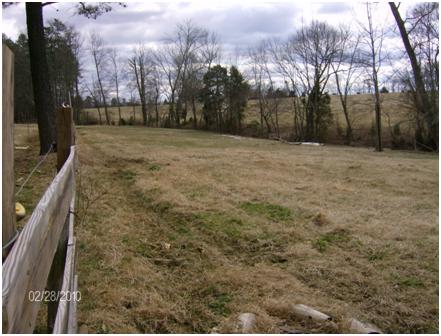
this is a view down the daily grazing lanes. The grass is currently 5 to 6 inches tall in these lanes. Clover is abundant with the wet year we have had.

This lot was broadcast with ryegrass and hairy vetch and lespedeza in mid March. However almost every lot has been broadcast with some sort of seeding so we have to start grazing somewhere.

The Ell actually has a bit more grass by volume but I desire to favor the bermudagrass out there and plan to take off the cool season grasses as the Bermuda breaks dormancy.


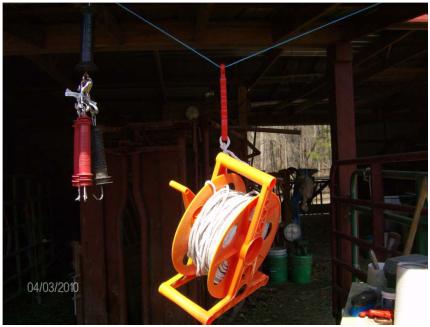
 this is what I refer to as an economy grazing wheel. The grazing companies sell nice metal and composite ones that should last a lifetime and they have hooks for hanging them up and they are very nice. They also cost about forty bucks each. This plastic extension cord reel cost less than eight bucks at home depot. This one has poly rope on it. I had a partial spool of poly rope. Most have 220 feet of polywire on each reel. 220 feet is probably as long a run as I will need to make, and the polywire comes on 660 foot spools. I put a no kick handle on one end so that I can unroll off of a hot fence if needed and rig up a regular handle with a double end snap on the other end so that I can quickly adjust and tension and hook up.


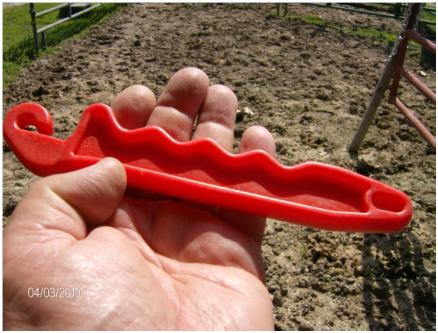
A no kick handle is a pretty simple affair. A piece of plastic with a hole in one end and a hook on the other. Since I have broken one already I may figure a way to make my own.


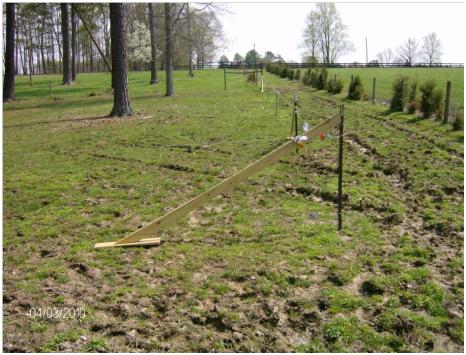
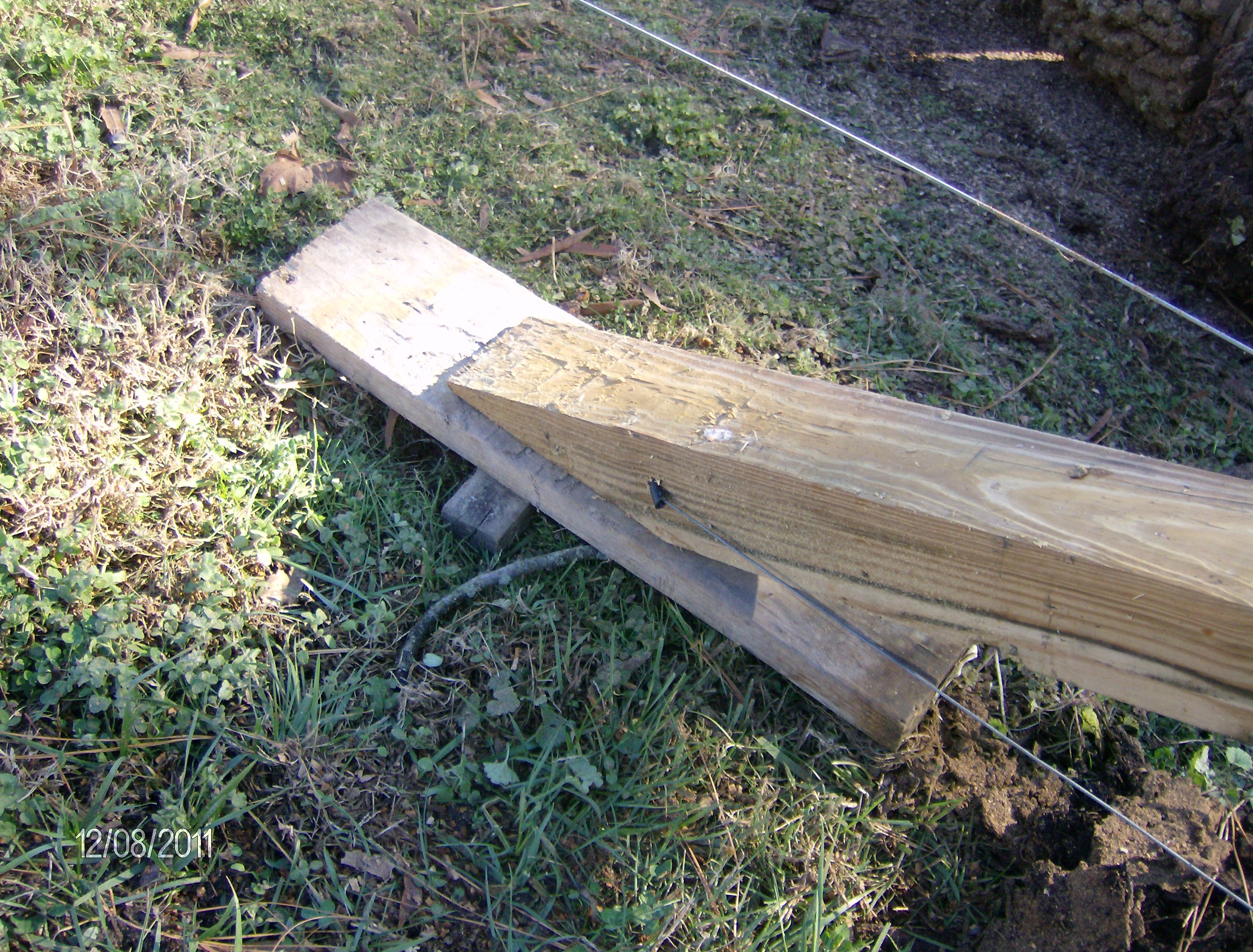
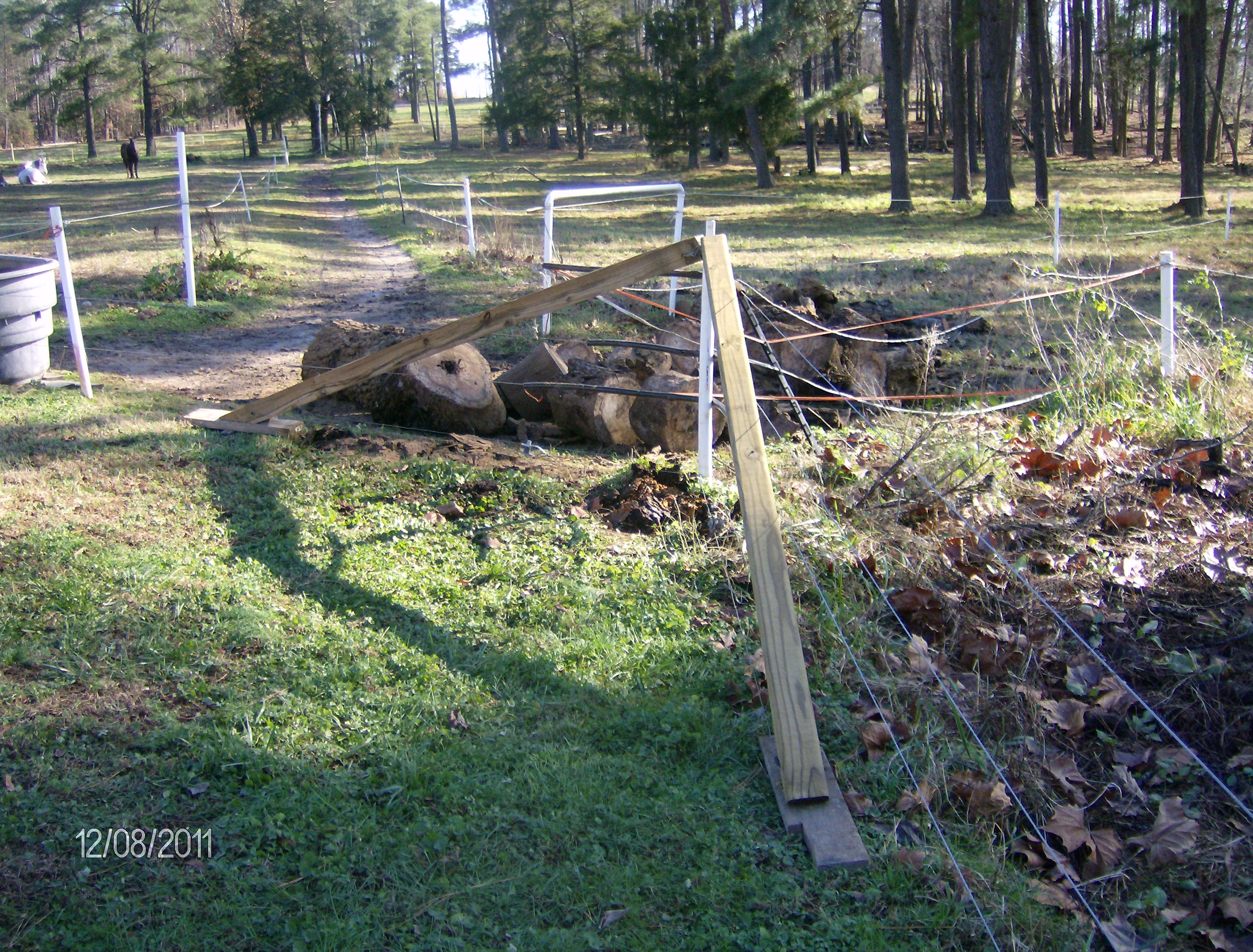
This is something neat I discovered on the Powerflex fence web site. It is called a floating brace. It is an answer to the needs of an arthritic old mans wrists. No need to tamp post or dig a hole to set a brace. Since I was only putting up one wire here, I cheaped out and used pressure treated 2X4 as the brace. For more wire a 4X4 would do better but other than that it is great. The foot is a two foot long section of pressure treated 1X6. I attached it to the 2X4 with a couple of screws. I attached the top of the 2X4 to the post with wire and tightened the brace with a fence strainer. The brace will bend the post.


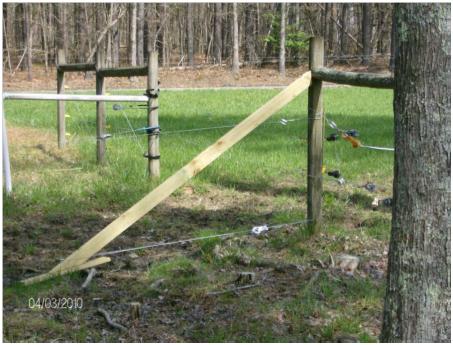
Works on a wooden post as well. This one is at a funny angle because the foot is actually sitting on a tree root. Should not sink in the mud. It is muddy in that spot now. The fence strainer is easier to see in this photo. One of the screws I used is an eye bolt screw and I ran the wire through the eye to prevent creep or splitting the brace.

 VDOT puts water on my property at four different points across my short road frontage.

We have had a LOT of water this winter and my place is still damper than most in the area. Star Baby loves to run and spray mud.


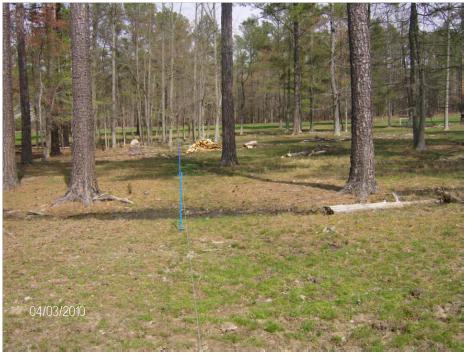
on the right in the photo is a new area that we fenced in and broadcast two weeks ago with rye grass, hairy vetch, lespedeza and some leftover tillage radishes. Just getting the horses off of it has started it to green up compared to left of the blue posts where they still are. The blue posts are Obrien Tread in posts. They are far superior to the ones in the feed stores around here and are no more expensive. They are made with a better resin and are much stronger.

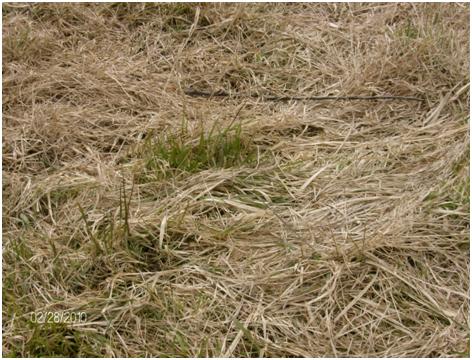
 The lespedeza is beginning to sprout …..Look closely in the track…….

The ryegrass and the vetch are not yet visible. Some of the tillage radishes seem to have sprouted as well. Could not get a good picture of them.

Aim to begin Grazing around Tax day  and will report more then.


PIPE DREAM FARM MANAGEMENT INTESIVE GRAZING EXPERIMENT


PIPE DREAM FARM
MANAGEMENT INTESIVE GRAZING EXPERIMENT

BACKGROUND INFORMATION

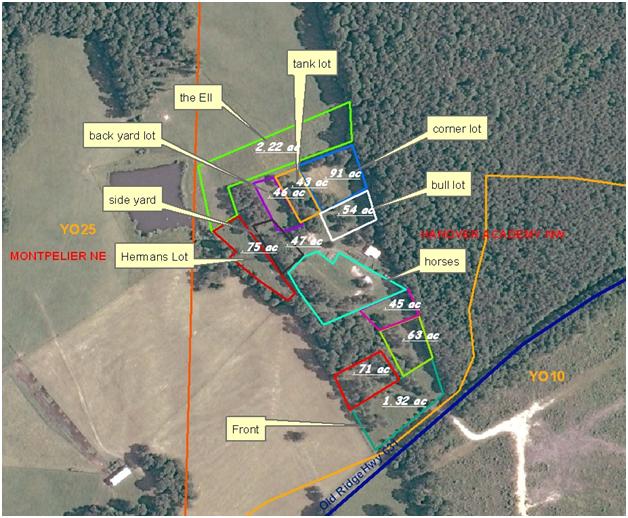
This is an aerial photo of my home, known to me as Pipe Dream Farm. For over twenty years my neighbor and I had a joint venture herd of registered angus cattle. He had the land and I had the experience and skills and we shared the love of the cows. The rascal came down with Cancer and thirty days after he was diagnosed we buried him. At least he did not suffer long. Two years later I miss him still. About that time I was diagnosed with rheumatoid arthritis.
Anyhow to make a long story short we dispersed the cow herd and I have a small hobby herd of three cows with calves now. We also have a couple of equines but they will not be a part of this study in any major way. They have their own area where they are rotationally grazed.
I have been practicing rotational grazing to some extent for over twenty years and have the place divided into small lots. In recent years I have subdivided lots using portable fencing. Every division gave me more benefit and ability to manage the land.
In January of 2010 I had the opportunity to meet Greg Judy and hear a presentation on how he manages pastures and makes money on cows and goats. This is no minor accomplishment.
I was inspired by what I heard and decided that the time was right for me to try to do better as well. My employer Hanover-Caroline Soil and Water Conservation District enables me to use this personal experiment as an educational tool as well.
I am working with JB Daniel, the NRCS Forage Agronomist, to do a case study and JB has already given me great guidance.
We are beginning by documenting the existing conditions.
The Ell is land that is actually owned by my neighbors estate but I still have the use of that acreage from the heirs. Similarly the paddock labeled Hermans Lot. Herman was Jack’s last Hereford bull before we switched to all angus. We built the lot for Herman to gain control of the breeding season and I housed and managed our bulls ever since and raised the heifers.

The Ell was last grazed in the fall of 2009 but after frost. We had a significant accumulation of bermudagrass over the summer when it was only lightly grazed. After frost the Bermuda was not prized by the cows and as a result a good bit of residue was left on the entire field.
This residue gives me a running start on the Judy management philosophy which is graze fast. Allow the cows to eat the chocolate and trample and fertilize the rest to add organic matter to the soil and move em on and rest the field.
Management intensive grazing is all about managing the grass and the organic matter and allowing proper growth and rest.
This field was last fertilized with bioisolids in the fall of 2008. This field is still permitted for biosolids and we anticipate another application in the fall of 2010. This is the only part of the project that is permitted for biosolids. Hopefully application will not interfere with the grazing schedule significantly.
The plan is to offer 5.4 animal units about 2000 square feet of grazing area every day and move them daily. I estimate the Ell will offer 39 days grazing.

Herman’s lot is still historically used for bulls and this past fall we had three young bulls and they grazed this and other lots pretty hard.


Again a stand of fescue and bermudagrass. The treed area is a fenced off stream that feeds the pond. There is a Mirafount frost free water trough in the fenceline but our of sight in the photo.
Hermans lot is estimated to offer 10 days of grazing.
This lot has had annual fertilizer until last year where it received none.
This field was frost seeded with Korean lespedeza on 2/27/2010

This is the front of the property and has been divided with portable fence into four lots and rotationally grazed.

The plan is to leave the center more permanent portable fence and MIG graze from gates on each end.
The front is estimated to offer 20 days of grazing.
This area has not been fertilized in three years and was limed two years ago.
This area was frost seeded with Korean lespedeza on 2/26/2010

This is the back yard field which is oddly the field behind my house.


This was used as a rotational bull lot for the last several years along with Herman’s lot and two other areas. This paddock was broadcast with ryegrass and hairy vetch in the late fall of 2009.
It has not had significant fertilizer in three years, nor lime in two years.
Estimated to have 9 days MIG.

The remaining lots along the driveway were similarly grazed and managed and are a bit wetter in wet parts of the year. They were also broadcast with ryegrass and hairy vetch in the late fall of 2009. There was germination before hard weather set in. I estimate 18 to 20 days grazing there. The trees make it difficult to estimate acreage from the aerial photo. I don’t have a current photo. The photo below shows it after our first big snow

Another significant area is known as the corner.
This .9 acre lot had cattle in it until February. Three cows with calves and one bull. This photo from 1/23/10 shows the ground cover.


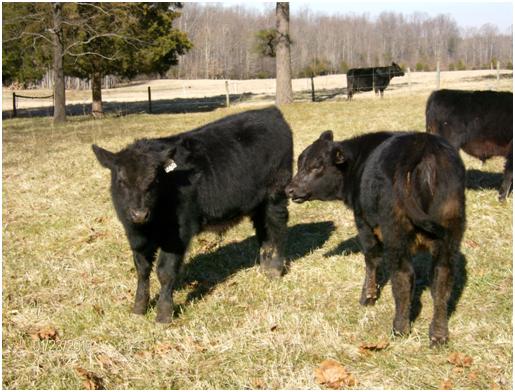
This lot was broadcast to Korean lespedeza and ryegrass and vetch on 2/27/10. The corner is currently divided into two lots but is estimated to offer 18 days of MIG grazing. Pictured are Ulysses and Ursula who are both already registered and the future of my herd. They are both sired by Diamond D Sure Enough 6D.
This lot is projected to offer 18 days of MIG grazing.

Warm Season Grasses


Tate’s Tips
A Series of Reflections on growing grass for forage

Issue 6.

Warm Season Grasses

The first few paragraphs should look familiar to those who have followed the series as they are directly from the last article, but a good review.

There are many classifications of plants.

There are annual plants and these are plants that usually grow for a single season or a single crop. Annuals include tomatoes, potatoes and, in fact, most vegetables; corn, wheat, beans and most other commodity crops and forages such as Oats, millet, Crimson clover, sudex, sudan grasses and turnips, canola and other brassicas.

There are a few biannual plants which have a two year life cycle. The most notable of these from a production standpoint would be red clover, a very useful legume. Another would be Canada thistle, a weed.

Then there are longer lived plants which are known as perennials. Their lifespan is determined to a large degree by the growing conditions and management they are exposed to. These would include many of the common pasture and hay grasses such as Orchardgrass, Fescue, Bluegrass, Timothy, Switchgrass, Indiangrass, Bluestem, Bermudagrass, Crabgrass and legumes such as White Clover, Ladino clover and several other clovers, Alflafa, Birdsfoot trefoil and lespedeza.

Some plants like ryegrass have cultivars that are annual and others that are perennial. Crabgrass can come back from the roots but it sets so many seed so quickly, that once you have a good stand it will stay with you for a long time.

Of the plants named above, many were warm season plants and some were cool season plants.

Corn is the ultimate warm season plant. When it is so hot and sticky that you are uncomfortable; corn, given adequate moisture, grows so fast that the growth is almost visible. In the late spring you can measure a day’s corn growth. However any frost will damage corn terribly as it does not tolerate cold weather.

Okay….now we will start fresh.

This year (2010) has made me look like a genius to those who have read the previous articles. Sadly it is just the accumulated wisdom of a lot of bad luck over a lot of years. It is late August 2010 as I address keyboard now.

Everything bad in weather has been dealt to us in spades this year. We had record snow fall in the winter and the wettest winter on record. When spring finally came and it stopped raining, forage producers went to the hayfields this spring, where they found thin stands and reduced yields. We can only surmise that many of the grasses drowned out in the winter and wet spring. Not all farms saw significant decline but many did.

The spring started off like gangbusters otherwise. At first we had what appeared to be the most uniform and potentially best corn crop that I have ever seen in this area. Everywhere I looked corn was beautiful and growing like gangbusters. It was uniform because the wet ground had kept everyone from planting until the ground dried out enough to get equipment on it.

It was beautiful and just about to tassel when the weather changed. Late May it got HOT and it Got DRY. One thing about corn is that it needs moisture when it is in the reproductive stage commonly referred to as tasseling. Corn can stand hot weather but it has to have water. 105 degree days took water away from the soil as if it were being drained. This is the exact opposite of what was needed.

I have been around here a lot of years and I do not recall a year where the corn had no ears. That was the case in a lot of fields this year. Some of the guys say 1977 was as bad. I was in Ohio digging out of snow that year.

When there is not enough water for corn to make ears……..and the weather is hot…..then cool season grasses are in trouble.

Grass weakened by the wet weather and then mown or grazed and then baked for weeks on end…..will mostly be reseeded or overseeded this fall. (We have two no till drills that we rent out for reseeding use.)

The bright spot in many places has been the warm season grasses. At my place, bermudagrass, or common wiregrass, has saved my butt this year. That and the fact that I have been doing Management Intensive grazing has kept me grazing all summer while all around me have been feeding from the short hay supplies harvested in the spring.

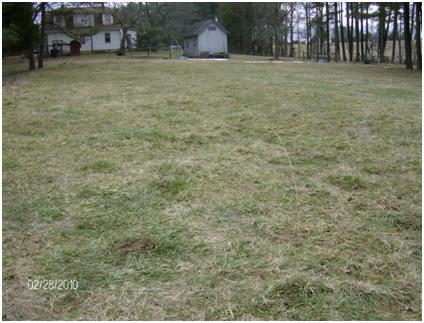
The photo below was taken of a daily grazing strip which had just been grazed. The date on the photo is 5/15/2010. The clumps are remnants of cool season grasses and the finer stuff is bermudagrass that was just emerging and spreading to fill in the voids. At that time I was worried about it but now am thankful it did.

The bermudagrass is the only thing I had to regrow after first grazing up until two weeks ago when we finally got a shower or two of rain. My cows and horses have been living on bermudagrass and the occasional sprig of crabgrass since mid early June.

Retired NRCS agronomist Glenn Johnson told me many times that he thought that Eastern Virginia forage producers were missing the boat by not using more Bermuda and crab grasses and overseeding them in the fall with rye and ryegrass. I have perennial ryegrass on my shopping list for this week. Because I know that when frost hits the Bermuda I am out of grass.

Warm season grasses will not stockpile like fescue. Well you can grow a pile of it and leave it out there but when it is frosted it goes dormant and loses feed value rapidly.

The nature of warm season grasses is they are only of value when it is warm. Even warm season grasses need moisture though.  the value of warm season grasses is that they grow at a prodigious rate makeing lots of forage in a short time.

I got a phone call from an old friend and a former boss, ( I feel proud of myself to count a former boss as an old friend) who had planted some Teff grass this year and he was bragging on it and sent me some photos. He was waiting for it to quit raining so that he could mow it again.

This photo was taken in southwestern Hanover county in August 2010. The teff was seeded I think he said in June. He has planted some for grazing as well and says Hereford cows love it and it holds up fairly well if given some rest.

Looks like a good leafy forage that he says makes excellent hay of good nutritional quality

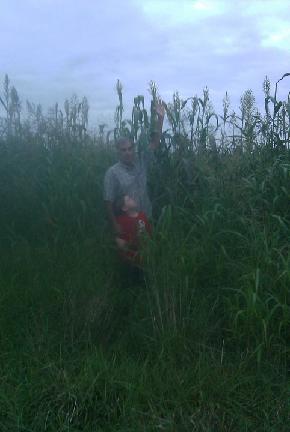
My son is farm manager on a good sized farm in Goochland and he addressed the hay shortage by planting two warm season annuals…..brown top millet and sudex. He has baled a section of the millet and got 83 round bales but I do not know the acerage. He is mowing the sudex pictured below today and says it is now ten or twelve feet tall and he is expecting 400 round bales. This is too tall to be optimum but the rain of the last two weeks, and they have had substantial rain over there, has prevented harvest. Even over mature hay is “Better than snowballs” as old Tom Goins used to say to me many years ago.

These are but some examples of warm season grasses and the benefits thereof.

Warm season grasses are grasses that oddly enough grow in warm season of the year. Most do not even begin to be productive until it is nearly hot. They are not drought proof and need water to survive and thrive. They will survive generally with less water than cool season grasses require.

Warm season grasses can be annual or perennial.

Annuals include millets, sorghums, sudexes, sudan grasses, forage peas Johnson grass and some newer stuff like Teff grass.

Perrenials include bermudagrass, crabgrass, switchgrass, bluestem, indiangrass, buffalo grass and others.

Bermuda and Crab are lower growing and both are actually not native to our area. But they are easily grown and have a natural place in forage rotations. Many of our cool season pastures actually have a significant amount of Bermuda and crab in them but they are not noticed as the livestock like them very well. Crabgrass is very palatable to most livestock. Dr. Teutsch is doing significant research on these alternative feeds at the Southern Piedmont Agricultural Research Center.

Further south Bermudagrass is big business. Most varieties are hybrid and are planted by sprigging vegetative cuttings. There is not much sprigging equipment to be found in Va. In the last few years a few seeded varieties of improved Bermudagrass have been developed and are commercially available. There are now improved crab grass seeds available as well. Dr. Teutsch has indicated that some of the local common Bermudas are doing very well in his research.

The others grasses above are termed native grasses and there is a long list of them. They make good forage, require low inputs, are adapted to our area and provide tremendous wildlife benefits, but they cannot stand close or continuous grazing and are more difficult to establish. They are more suited to mechanical forage harvesting, but as large bunch grasses they require a different management than our cool season hay mindset. These forages are also seeing increased used as biomass fuels. Those growers are teaching traditional producers how to manage these ‘new ‘old crops.

Monocultures are not nature’s way. Forage species diversity is good and should be encouraged. As people we have aesthetic landscapes in our minds eye as goals but those goals are difficult and expensive because you have to defeat Mother Nature to get there.

Some of the best graziers in our country value their pastures by the number and diversity of species of grasses that exist in the pasture.

Our new “traditional” “production driven” agriculture has given us the technology to strive toward the desired monocultures. I am not sure we know the true cost.

The older I get the more I see that it is a lot easier to work in concert with mother nature than it is to battle her. I try to approach all things with a mind toward moderation. I strive not to be an extremist in any direction, although some would paint me as the poster child of some extremes. I am currently trying to reduce inputs and increase management and observation. It costs me very little to observe nature at work.

My observation today, is that warm season forages have a place in our systems. We need to embrace them and determine how we can best utilize them in a balanced forage production scheme.

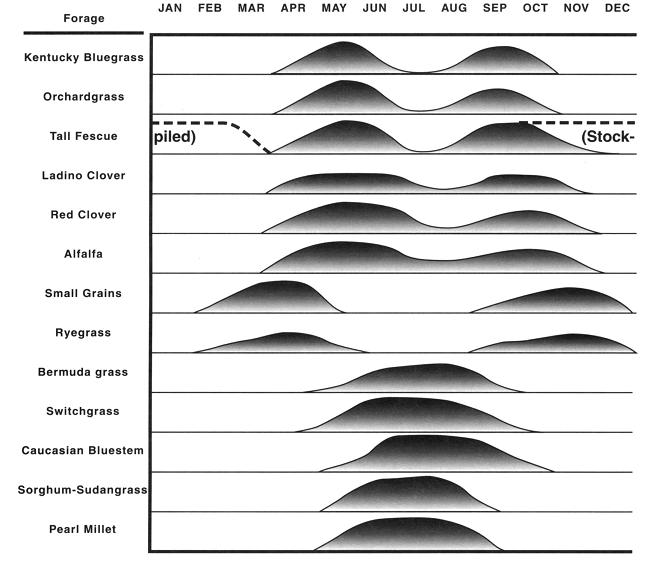
Some excellent reference reading links are below for those who want to learn at a more in depth level as well as the forage seasonality chart. (EVERY Forage grower should know this chart by heart).

The first two are basically the same. One is a web page and the other is a PDF file. I find the PDF file to be more useful.

The third link is to a list of publications by Dr. Chris Teutsch who is Virginia’s current leading authority on forages.

Click to access 418-012.pdf

http://www.pubs.ext.vt.edu/418/418-012/418-012.html

http://www.arec.vaes.vt.edu/southern-piedmont/people/teutsch/index.html

http://pubs.ext.vt.edu/418/418-105/418-105.html

Chart taken from controlled Grazing of Virginia’s pastures

Cool Season Grasses


Tate’s Tips

A Series of Reflections on growing grass for forage


Issue 5.


Cool Season Grasses

 There are many classifications of plants.

 There are annual plants and these are plants that usually grow for a single season or a single crop.  Annuals include tomatoes, potatoes and, in fact, most vegetables;  corn, wheat, beans and most other commodity crops and forages such as Oats, millet, Crimson clover, sudex, sudan grasses and turnips, canola  and other brassicas.

 There are a few biannual plants which have a two year life cycle.  The most notable of these from a production standpoint would be red clover, a very useful legume.   Another would be Canada thistle, a weed.

 Then there are longer lived plants which are known as perennials.  Their lifespan is determined to a large degree by the growing conditions and management they are exposed to.  These would include many of the common pasture and hay grasses such as Orchardgrass, Fescue, Bluegrass, Timothy, Switchgrass, Indiangrass, Bluestem,  Bermudagrass, Crabgrass and legumes such as White Clover, Ladino clover and several other clovers, Alflafa, Birdsfoot trefoil and lespedeza.

 Some plants like ryegrass have cultivars that are annual and others that are perennial.  Crabgrass can come back from the roots but it sets so many seed so quickly, that once you have a good stand it will stay with you for a long time.

 Of the plants named above, many were warm season plants and some were cool season plants.

 Corn is the ultimate warm season plant.  When it is so hot and sticky that you are uncomfortable; corn, given adequate moisture, grows so fast that the growth is almost visible.  In the late spring you can measure a day’s corn growth.  However any frost will damage corn terribly as it does not tolerate cold weather.

 On the other hand small grains like wheat and barley and rye and canola are cool season annuals that in our state are planted in the fall and they overwinter to flower and fruit in the spring.  They tolerate cool weather better than corn and in fact do not perform as well in summer heat.  There are western varieties that are grown in the northwest United States that are summer varieties.  Plants are amazing at their ability to adapt and perform in so many different environments.

 The focus of this article is intended to be on cool season perennial forages that are common to Virginia.  Within this category, what is common in the eastern coastal plain and what is common in the mountain west and southwest parts of the state may be very different.

 Let’s start simple.  Cool season grasses prefer the cool seasons of spring and fall.  Freezing weather will cause them to go dormant, but they overwinter well.  Hot dry weather will cause dormancy too and extreme heat and dry can be fatal to some cool season grasses.  Generally cool season grasses and mixtures should be planted in the early fall.  They can be planted in the spring but weed pressures and environmental factors are more inhibiting to a successful establishment.  Summer and winter plantings need extreme luck and management to survive.

 Oats is a cool season plant that has varieties that can be planted in the fall called winter oats, and also there are spring planted varieties called spring oats.  Spring Oats are not cold tolerant and will winter kill.  Both are annuals and both can be used as forage as silage or hay or harvested at maturity for grain and straw.  The spring oats would mature at a later date.  Once harvested they are essentially done.  Oats are sometimes used as a nurse cover crop for new seedings of perennial forages.  Now wasn’t that easy.

 Timothy  is a cool season perennial except in the eastern half of Virginia.  While it is excellent forage and makes good grazing or hay, it is not hardy enough to persist in the hot and dry part of the commonwealth.  The hay producers in eastern Virginia interseed timothy annually in their hay fields to provide it to the customers who prefer it.  A spring cutting can be made and then the timothy perishes due to heat and dry conditions.  Basically one could say it is the coolest of the cool season grasses with no tolerance for hot dry conditions.  It can be a perennial in the high mountains and in southwest Virginia.  See still easy.

 Bluegrass  is a cool season perennial that will persist under hay making conditions and will survive the stress of hot and dry.  It will not be productive during that time but it will survive.  It is a smaller finer forage that makes excellent forage but lesser tonnage than some other grasses.  Does not handle stress and close grazing so it does not survive well in continuous grazed pastures.

 Orchardgrass is a cool season perennial that is close to blue grass in hardiness.  It is a larger and more productive plant and has a deeper root base than bluegrass.  Recall that the more plant we have above ground the more root mass we have underground.  It produces excellent quality forage and under well managed hay programs I have observed stands of Alfalfa and Orchardgrass that were 18 years old.  It will persist in summer with moisture.  If temperatures are moderate and moisture is adequate it will produce multiple hay cuttings.  If these conditions are not met it will simply go dormant until favorable conditions return.  It also is excellent pasture forage but it must have rest.  Continuous grazing will kill Orchardgrass.  Extreme drought will also kill Orchardgrass but it will survive a typical Virginia summer.

(Please refer back to Issue 2, How does your Plant Grow? For a refresher on this concept.)

 Now having read the refresher and eaten a few cookies, this too is simple, Right ??

I should not reveal all this as we make good money for our scholarship fund renting no till drills to folks who plant Orchardgrass every year.

 Ryegrass is both an annual and a perennial depending upon the variety.  It is a vigorous and copious seed producer and if allowed to set seed will be a recurring annual.  Rye grass is an easy starter and a vigorous grower and produces high quality palatable forage suitable for pasture and for hay or silage.  It is useful for getting fast establishment on bare areas and is tolerant of a wide variety of growing conditions.  It also is not a heat tolerant plant in either annual or perennial variety.  It is the first grass to green up in the spring and the last to quit growing in the fall and I include it in my recommended mixes as it has the greatest chance at establishment.  As a cool season grass it is virtually dormant in most summers but will reemerge with cooler weather and rain. 

 Use ryegrass with caution if you adjoin a small grain production field.  Ryegrass is a serious weed in small grains and is invasive and difficult for grain producers to control.  I have no desire to be implicated in causes of gunplay between neighbors.

 Have you noticed a trend yet?

All of these grasses in most Virginia summers experience what is called summer slump.  The heat and dry conditions are just too much for them and they shut down until conditions improve.  Some more than others.   Everything is still simple so far except that we don’t have any summer grass yet.  We will get there later.  Refer to the chart below taken from Controlled Grazing of Virginia’s Pastures for a graphic representation of what we have discussed so far.

 Fescue is the most common and most abundant and hardiest and most productive of the cool season grasses.  Fescue stands up to hard grazing better than any of the other cool season grasses.   It will still have a summer slump because it is still a cool season grass.  But it will survive.  Fescue is a bit less palatable than some of the other grasses.  It still makes good forage and grazing but given a buffet of ice cream, pizza, hamburgers, and brussle sprouts, the brussle sprouts don’t have to worry about me bothering em.  Fescue is the forage equivalent of brussle sprouts.  Eat em cause they are good for you.  Yeah Mom, soon as I polish off this pizza.

 Animals select the most palatable plants first and go back for regrowth as soon as it appears.  They will graze around the tougher fescue until the ice cream is gone and then they will eat the brussle sprouts (fescue).  This natural animal tendency puts negative pressure on the Orchardgrass and positive selection pressure on the fescue.

 Fescue is a complicated grass as well.  It gets a good part of it’s hardiness from an organism called an endophyte.   The endophyte is a microscopic organism that lives in fescue and concentrates in the seed heads.  Rather than pay rent the endophyte benefits the fescue plant contributing to the plants hardiness. 

 The endophyte also has the side effect of some toxicity to animals.  In cattle it increases summer slump by restricting blood flow in the animal and creating over heating problems and thereby suppresses animal production and performance.  It can have reproductive repercussions as well in cattle.

 In horses the problem is in pregnant mares.  Pregnant mares exposed to the toxic endophyte with have a high percentage of foaling problems.  I will leave it to discuss with your equine practitioner for specifics. 

 Once the troublesome endophyte was discovered quite a few years ago, enterprising plant pathologists were successful in removing the endophyte and created;

  Endophyte Free Fescue  Seed is available for endophyte free fescue today and it eliminates the toxicity problems of fescue.  In fact it made fescue a more palatable plant and made it more like Orchardgrass.  The problem is that the endophyted free fescue is now no hardier than Orchardgrass.  For the good forage manager this is not too much of a problem as the fescue can be managed right along with the Orchardgrass.  For those who overgraze…..you just ran out of grass again.

 The newest option is a fescue which has been developed with a novel endophyte that gives the fescue its hardiness back and yet eliminates the toxicity of old Kentucky 31.  Only one seed company has this product and the seed is a bit expensive but it is a good product that works.  Over time native Kentucky 31 can infiltrate a stand of Endophyte friendly fescue and it is not discernibly different.

 My advice for mare owners is to keep pregnant mares off of fescue and cattle can be selected for fescue adaptability as some cattle are much more tolerant of it than others.  Interseeding of fescues with other grass and particularly legumes is of great benefit.  Pasture management is an integral part of managing the toxicity problems.  Clipping of seed heads reduces problems greatly as well.

 Matua  is a new variety of brome grass that seems to be relatively well adapted to Virginia.  It is a good and vigorous producer but needs management similar to Orchardgrass to maintain a good stand.

 We have yet to cover warm season grasses or legumes.  We will hit those in the next two topics.

 Some excellent reference reading links are below for those who want to learn at a more in depth level as well as the forage seasonality chart.

 The first two are basically the same.  One is a web page and the other is a PDF file.  I find the PDF file to be more useful. 

 The third link is to a list of publications by Dr. Chris Teutsch who is  Virginia’s current leading authority on forages.

 http://www.pubs.ext.vt.edu/418/418-012/418-012.pdf

 http://www.pubs.ext.vt.edu/418/418-012/418-012.html

http://www.arec.vaes.vt.edu/southern-iedmont/people/teutsch/index.html

 http://pubs.ext.vt.edu/418/418-105/418-105.html


 Chart taken from controlled Grazing of Virginia’s pastures

Nutrients


Tate’s Tips
A Series of Reflections on growing grass for forage

Issue 4.
Nutrients

Since I have gone fairly basic on this series, I might as well continue with some fundamentals.

The most fundamental elements of growing forages are the nutrients. I will try to address nutrients from a layman’s viewpoint. I will address them in what I think are the order of importance.

The most important nutrient for forage production is plain and simple water. If we have rain at normal intervals and in appropriate amounts then grass will grow. Three months of hot dry weather will leave you with nothing and you can only hope that when rains return the forages will come out of dormancy and regenerate. Enough hot and dry weather can kill any stand of grass that has been otherwise stressed. That suggests the topic of supplemental water or irrigation but we will save that as a separate topic.

Normal rainfall in central Virginia is historically about 42 inches per year. If all things were equal then that would be 8 tenths of an inch per week. But nature is seldom that predictable. 2003 is the last excellent crop year we had across the board in our area. 2009 was not a bad year but the weather patterns were extremely spotty. Parts of Caroline county suffered horribly under drought. Other parts had a great crop year.

Rainfall volume this fall has been unprecedented in my lifetime. None of us has much influence on the weather so we have to take what we can get and deal with the averages.

I deal with all kinds of crops but in this series I am talking mostly about grass forages. Summer of 2002 was a brutally dry year. But that fall in early September we had a tropical storm that brought four or five inches of rain and grass that was brown and dry sprang to life and grew at a prodigious rate through the early fall. Even fields that were a bit short on other nutrients, experienced what I refer to as compensatory growth and put forth good growth in an effort to rebuild their root reserves and survive. 2003 followed with a year of moderation in summer temperatures and regularity of rainfall. It was an excellent forage and livestock year.

Forages need water to survive, produce, flourish and reproduce. It is the first and most limiting nutrient. Nothing grows without water. A couple of years ago there was big news all over TV and the internet that Death Valley was in bloom. It had experienced the first significant rain or possibly snow in something like twenty years. In just a few weeks plants emerged, flowered, set seed. Death Valley was a place of beauty and grandeur, but it grew hot and dry again and the plants wilted and then faded under the unrelenting sun and temperatures of the climate. But those seed will lie in wait for the next rain. We have all seen the monsoon shows about the perils of the rainy and dry periods in Africa.

Normally here in temperate Virginia things are a bit more even but Mother Nature can be a cruel taskmaster. We have to talk about normal conditions, acknowledge the possibility of abnormal conditions and hope for the best.

This fall we have been dealing with scattered reports of Ark building.

Nationally syndicated garden talk show host Andre Viette recommends watering lawns deeply and inch or two at a time once every ten days. 1.15 inches of rain every 10 days would give us our annual average of 42 inches per year. Of course a little more in the hot summer and a little less in the winter would balance things nicely. But then July and August are typically the heaviest rain months of the year anyway. See……. Ma Nature is trying to help us along.

links to climate data for Ashland Va. below.

http://www.usclimatedata.com/climate.php?location=USVA0028

http://www.climate-charts.com/USA-Stations/VA/VA440327.php

This year we went into the fall with a rainfall deficit of about 9 inches. After the rainiest November on record we are now going into winter with a rainfall surplus. Not to mention the mud surplus.

So water is the most limiting nutrient and it is the single factor that usually will make or break any cropping enterprise.

The second most limiting nutrient is pH. pH is the measure of the level of acidity or alkalinity in the soil.

Basic information. Most but not all crops prefer a pH range of 6.0 to 6.8 with 6.0 being a bit low but acceptable and 6.8 being a bit high. There are some acid loving plants like azaleas and such that prefer a lower pH but most agronomic crops will fall within the 6.0 to 6.8 range.
What does pH mean?
This is a measure of how acidic or alkaline a substance is. The initials pH stand for “Potential of Hydrogen.” Acids have pH values under 7, and alkalis have pH values over 7. If a substance has a pH value of 7, it is neutral-neither acidic or alkaline.

Because the pH scale is logarithmic, a difference of one pH unit represents a tenfold, or ten times change. For example, the acidity of a sample with a pH of 5 is ten times greater than that of a sample with a pH of 6. A difference of 2 units, from 6 to 4, would mean that the acidity is one hundred times greater, and so on.

From the above information you can quickly see that the range of 6.0 to 6.8 is actually pretty broad with 6.0 being eight times more acid than 6.8.
So what does this mean when trying to grow grass? It means will your grass be happy and survive and thrive in the pH of the soil you want it to grow in. It also determines whether or not the other expensive nutrients will be used by the crop you want to grow. Excess acidity or alkalinity can inhibit uptake and use of expensive fertilizers.
At risk of sounding like a broken record the first step to good agronomy is a proper soil test. The soil test will give you a minimum of the soil pH and the Phosphorous and Potassium levels. Most soil test will give you a recommendation of what is needed if you provided information on what you wish to grow.

In this part of Virginia the natural condition is for the pH to be low. Forest land or fallow land will typically test down to 4.5. Streams running through significant portions of such land will also test low in pH. Newly cleared land in our area will almost always have a very low pH.
To correct low pH the cure is the addition of Lime. The standard for lime is Calcium Carbonate equivalent. Limes from various sources vary and the proper amount needs to be adjusted to meet the calcium carbonate equivalent. Lime may be from ground Limestone, hydrolytic lime, calcium carbonate or calcium sulfate (gypsum). Lime is usually broadcast by the ton or part thereof.
In no case is it beneficial to apply more than two tons of lime per acre. That is the maximum amount that the soil biota can metabolize and make use of. Lime does not immediately take effect. It is a slow and biological process. If pH is extremely low the standard advice is to apply up to two tons of lime in a given season and retest the soil annually for additional recommendations until proper pH is reached.
As mentioned above the level of the pH impacts the effect of other nutrients. Soil nutrition is chemistry and I am not a chemist.
Low ph is like trying to grow something in battery acid.
High pH is like trying to grow something in baking soda. Neither is a very good growth medium.
Potassium and Phosphorous are two widely needed nutrients. If you add Phosphorous to acid you will make some amount of phosphoric acid. Plants won’t grow in phosphoric acid either. If you add potassium to baking soda you will make some amount of Potassium Hydroxide which is a strong caustic and nothing will grow in that. So getting the soil pH correct is the first step to adding nutrients.
An additional good discussion of this topic is available at
http://www.heronswoodvoice.com/?utm_source=121509-Balancing-Garden-Soils&utm_medium=email&utm_campaign=Hvoice

Phosphorous this section is taken from earthworks at

http://www.soilfirst.com/tnm_02_1998.htm

Phosphorous is perhaps the most misunderstood of all the basic plant nutrients. An anion, phosphorous is very reactive, and often tied up in the soil with calcium and other cations. These calcium-phosphate bonds are often very hard to break, especially in biologically weak soils, leaving the plant deficient. Phosphorous is found in all plant tissue but is most pronounced in the seeds, flowers and youngest shoots. It is the backbone of many enzyme and amino acid systems, including photosynthesis. It regulates the breakdown of carbohydrates and energy transfer. Without phosphorous, cell division is weakened and plant growth suffers. These deficiencies can lead to plant stress, susceptibility to disease, insect attack, and even weed infiltration.
Potassium
Potassium is often referred to as “the band director.” It helps to direct free nutrients (such as carbon, hydrogen and oxygen) out of the atmosphere and into the plant. Without this activity photosynthesis would be severely restricted and the plant would struggle to make starches, sugars, proteins, vitamins, enzymes and cellulose. Potassium aids in helping the plant through the cold of the winter and the heat of the summer. In short, when potassium is out of balance plant stress is very high. However, one of the great fallacies in our industry is that you can not overdo potassium. You can overdo everything!
Potassium is a positively charged cation and should saturate only 3 – 5% of the soil colloid. When too much potassium is used, other important cations suffer, most notably calcium and magnesium. In fact, potassium can drive pH more aggressively than magnesium or calcium by quickly replacing them and creating an imbalance in base saturation. Potassium tends to be relatively mobile in the plant. When excesses occur not only does the soil suffer, but imbalances are created intra-cellularly and stress is actually created. As soil pH climbs above 6.5, potassium mobility slows down, and as the soil reaches 7.0 mobility is severely hindered.
Nitrogen
“..any nutrient introduced to the soil is first digested by micro-organisms before the plant has a chance to eat.” Joel Simmons
Without nitrogen there would be no photosynthesis and, therefore, no plant. However, nitrogen is also the most overused nutrient in our industry, and the negative impact it can have on the soil ( and water) can be tremendous.

Urea > ammonia (NH3) >
nitrite (NO2) > nitrate (NO3) >
into the plant.
(The arrows in this diagram represent soil microbes which are responsible for breaking down the nitrogen fertilizer into plant usable forms.)
Nitrogen (N) is a key nutrient in manipulating plant growth. Most nursery/floral producers use large quantities of N fertilizers in a “blanket” attempt to meet the needs of their crops. However a thorough understanding of N nutrition Can be useful in optimizing both the concentration and form of N best suited for the plant species, stage of growth, time of year and production objectives.

Plants require N in relatively large quantities and in forms that are readily available.

Nitrogen metabolism is a well studied and a vital aspect of plant growth. Nitrogen is one of the important building blocks in amino acids:
H

R C COOH

NH2
Amino acids are typically made up of an amino group (NH2), carbon (C), a carboxyl group COOH), and a variety of molecular structures (R) which define individual amino acids (glycine, serine, licine, alanine, etc.). When these amino acids link together in long chains they form proteins. Proteins are also vital components in a variety of metabolic pathways and processes. Proteins makeup the molecular structure of DNA, RNA and a host of other critical metabolic processes required for plant growth.

When N is deficient in plants restricted growth of tops and roots and especially lateral shoots may occur. Plants also become spindly with a general chlorosis of entire plant to a light green and then a yellowing of older leaves. This condition may proceed toward younger leaves. Older leaves defoliate early.
Since I am now on page 6, this might be a good place to stop and take a nutrient break and assimilate the little nuggets we have taken in so far.

Natures Puzzles


Tate’s Tips

A Series of Reflections on growing grass for forage


Issue 3.

NATURES PUZZLES


I have been reminded to tell folks that this is a blog which is basically one mans opinions and that I have no qualifications whatsoever to give any advice.  For real advice contact the Virginia Extension Service.  They are the designated hitters.

Now that we have discussed how plants grow in general, we ought to talk a little bit about the other factors that influence plant growth and the general balance of nature.

Plants are widely varied in nature and over the millennia have adapted to survive in a wide variety of situations and climates.  Giant fir trees grow in the Pacific Northwest United States.  Coconut Palms and Bananas grow in tropical climates.  The trees in a southern forest are not necessarily the same trees found in a northern forest.  In the southeast United States improved Bermuda grass is the standard.  In the North central and Northeast Fescue and or Orchard grass would be the standard.

There are wetland plants and dry upland plants.  Cold tolerant plants and heat tolerant plants.  Annuals Biannuals and perennials.  We will discuss all of these in turn.

The point is that nothing occurs in a vacuum.  People love to try to influence plant communities and exert their will, but every action in nature has a reaction.  Sometimes the reaction is good and sometimes it is not.  It is not nice to fool with Mother Nature.

One of the things that I deal with in my job is folks who wish to clear land for agricultural purposes.  Sometimes it is land well suited for agriculture.  Often times it is not.  Wetlands don’t make good agricultural land and in most cases today wetlands are protected.  Steep land which is covered in trees is covered in trees because people figured out years ago that trees were the best use for the land and that growing trees was easier than fighting erosion all your life.  Forest that is managed in a sustainable manner can provide income over the years, but most people today insist that it must be clear cut and replanted on a shorter cycle.  Sometimes all of our efficiency methods and improved management are not all that improved.  Nature does not grow tress or most other plants in a monoculture.

Steep land without a very good cover will erode when it rains.  Sometimes steep land with a very good cover will erode.  Mother Nature is sometimes a very cruel mistress.

But people who have purchased land figure they own the land and as long as they pay their taxes they should be able to do what they want to do.  This is true to some extent.  Landowners should be aware that wetlands greater than 1/10 of and acre ( that is 4,365 square feet or an area 66 feet by 66 feet) are under the jurisdiction of the Army Corps of Engineers.  If you want real trouble, just go fill in your jurisdictional wetland.   Also erosion from your land which fouls public waters is actionable.  But again I digress from the topic at hand.  I can’t help it.  I am from the government and I am here to help you. ( Please reread and repeat blog disclaimer above here.)

Plants help prevent soil loss.  Plants and the soil are intricately intertwined.  Yes there are plants that grow in a crack in a rock and there are plants that float but generally plants and soil have a dynamic mutual relationship.  Even in those examples plants are involved in building soil.   As we discussed previously, plants soil, water and sunshine and the magic of photosynthesis takes place.

If we are growing vegetables then the only thing else necessary is management to grow the preferred plant at the preferred time for the intended vegetable.

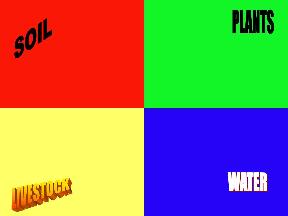
If we are growing grazing forages then in addition to management we may need to consider the livestock.  We have identified the basic pieces of a simple puzzle.  I borrowed this puzzle idea from Robert Shoemaker of Va. DCR.  He kindly offered me the use of his slides but after talking with him, I found it just as easy to create a few that were easily customizable.

The soil contributes basic properties of fertility and alkalinity or acidity, productivity, leachability, depth to bedrock, water holding capacity, cation exchange capacity, organic matter, particle size and topography.

The plant community must be adapted to the environment and sustainable in order to stabilize the soil and produce a useful energy product.  The plant interaction with the soil, its root penetration ability, Its water and nutrient uptake potential, its hardiness and its productivity are all factors.

Water and the water holding capacity of the soil and the depth to water table and annual rainfall will influence each particular plant species ability to survive in the given location.
Both of these factors influence what plants will survive on the soil.  If the plant that survives is a cactus or a red root pigweed then the livestock business is going to be tough going.  If it is a nice cool season grass mix with some palatable legumes, then things will be a little easier.

Similarly the livestock will have an impact on the soil and the plants.  Consider our previous discussion on the impact of too frequent grazing on young plants.  Different plants have different palatability’s and different animals prefer different plants.  Livestock also impact soil fertility through their grazing patterns and hoof actions and returns to the land and this distribution varies widely by species of livestock.

Then there is the wildcard.  Remember two of Mother Natures rules.

Nature abhors a vacuum.    Every action in nature will create a reaction.  You take something away and another thing will fill its space.

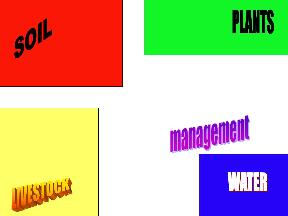
MANAGEMENT…..or lack of same…….this is the source of most problems.  Nature left to it’s own devices will find the proper balance of all the other factors.  Just as is the case in your and my jobs, unless you are self employed, that balance is usually not what is desired by MANAGEMENT.  Not all MANAGEMENT is evil.  Heck I have been a manager and even I am not totally evil.  But management will influence the natural factors.


Too much lime applied by MANAGEMENT will affect the pH of the soil which will in turn change the survivability of the plant species and this will effect the livestock and possibly the erosion potential of the land.  Eroding land will pollute the water.

MANAGEMENT with a goal of continuously stocking three cows per acre and maintaining Orchardgrass and clover better have a good plan B.  MANAGEMENT with a goal of stocking fifty head per acre on mixed grass pasture and moving the herd twice a day with 35 days rest between grazing might have a workable plan.

MANAGEMENT that tends to focus too much on one segment of production will invariably do so at the expense of the other segments.  In this example an over stock of livestock is at the expense of the plant, soil and water resources and MANAGEMENT is of reduced effectiveness.


In this example a reduction in water resources through a drought demands an increased level of MANAGEMENT to have any hope of salvaging anything like status quo in the other areas.  Typically in a water reduction situation all segments will be negatively affected but effective MANAGEMENT will minimize the negative impacts.

This is probably a more accurate depiction of how a drought situation would be graphically depicted.

This brings to mind some quotes I recently ran across from a noted grazier and cattle producer, Kit Pharo.

“As I travel around the country, I have found that many producers try to run enough cows to keep up with their highest grass production.   This forces them to feed hay when grass production decreases – often for several months.   The most profitable producers that I know of have a stocking rate that matches their lowest grass production.   For the most part, this eliminates the necessity of feeding hay.   To take care of their high-grass production periods, they utilize stocker animals – often of their own raising.”

Kit Pharo

“Although it has been well proven for over 20 years that we can dramatically increase grass production through Planned Rotational Grazing and/or Management Intensive Grazing and/or Mob Grazing, I suspect less than 5% of cow-calf producers practice any of these grass management concepts.   Why is that?”

Kit Pharo

Feeding hay is often the result of poor grass management and/or having too many cows.   Jim Gerrish says, “The average producer inMinnesota feeds hay for 130 days.   The average producer inMissouri feeds hay for 130 days – and the average producer inMississippi feeds hay for 130 days.”   What does this tell you?   Does it make sense?

Kit Pharo

“You MUST manage your land resources in such a way that you make the most efficient use of the FREE solar energy and rainfall that falls on it.   Planned Rotational Grazing and/or Management Intensive Grazing and/or Mob Grazing have been well proven to increase forage production (and beef production) by 50 to 200 percent – while improving the land.   WOW!   Believe it or not, the cost to do this is minimal.”

Kit Pharo

I believe all of the above to have a high degree of truth to it and these are all elements of MANAGEMENT.

Or as I heard one farmer say a long time ago.  “Heck man, I already know how to farm twice as good as I do now.  I just don’t have time to do it.”

But as my mother used to tell me, “If you have time to do it over, you have time to do it right.”

I would conclude by saying don’t let MANAGEMENT goals get in the way of proper management and environmental stewardship.  If it is good for the land and the environment, then it is good for you.

How does Your Grass Grow


Tate’s Tips
A Series of Reflections on growing grass for forage

Issue 2.
How does your grass grow?

I have been reminded to tell folks that this is a blog which is basically one mans opinions and that I have no qualifications whatsoever to give any advice. For real advice contact the Virginia Extension Service. They are the designated hitters.

In order to discuss forage management and culture we must have some fundamental understanding of grass.

While my agricultural career has been animal based, there would be no animals without the magic of plants. One thing that I have learned over the years is that all things are related and that you can not change one thing without having an impact somewhere else.

At risk of giving away one of my good routines with third graders when we are teaching about soils, I challenge them to give me the name of a food that they like to eat that does not come from the soil. We then go through a series of interactive questions tracing their food suggestions back to the soil. It is a simple and fun process where I get to see a lot of little light bulbs light up over some heads. A few blank looks as well but a lot of light bulbs, sometimes even from the adults with the kids. I usually end up by telling them that without soil we would not have anything to eat, no oxygen to breathe, and no wool or cotton or leather for clothes or shoes, no wood to build houses and no clean water to drink and that if we could survive we would be standing on a rock, naked and hungry and gasping for breath. I have had kids tell me eight years later that they remember that.

The point is that all things in the natural world are related. Like it or not we are a part of the natural world. What we do influences how we live.

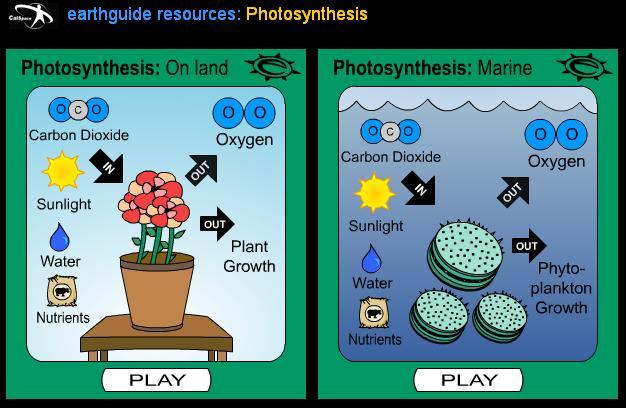
Grass is a fundamental part of that natural world. It is one of the miracles of the plant world. Plants perform the miracle of life every day. Plants take water and nutrients from the soil and through the miracle of photosynthesis, combine them with sunshine and create life and energy. That energy is stored in leaves and stems and roots.

Below is a graphical depiction of the process:

Just as described the roots take water and nutrients from the soil and carbon dioxide from the air and manufacture energy in the form of sugars and emits oxygen for the plant, giving us both energy and air.

The next illustration shows that the process occurs both on land and in the water with phyto-plankton being the basis of energy and life in the oceans. The smart third grade kids always think they have got me when they bring up a seafood item, but I am fortunately not nearly as dumb as I look.

For more detailed information on the processes above do some light reading on the Calvin Cycle which will take you through the chemical process of converting carbon into long chain sugars. That is more chemistry than I am capable of conveying.

The plant then uses the sugars for energy and for complex carbohydrate and protein building and in many cases conversion to lignin which gives the plant its structural component. The more complex the component that the plant builds then generally the less digestible the plant is and the more long term and woody the plant becomes. But photosynthesis is the engine that drives it all. Take away the sunlight…….Game over. Take away the water…..Game over. Take away the nutrients……..you guessed it, Game over.

Plants start from seed or in some cases from vegetative cuttings. At first they are energy users. Seeded plants rely on energy stored in the seed to produce a tap root and the first leaves. As the root begins to accumulate moisture and nutrients the leaves begin the photosynthesis process and the plant builds itself and begins to store energy. The stored energy is what we benefit from when we eat corn or rice or beans or any other type of seed crop. That is the energy that is to sustain the new plant.

The plant builds itself by adding leaves and stems and roots. Generally for every bit of plant that you can see above ground there is an equivalent amount of plant underground. Energy is stored in all parts of the plant but the main functions of the root are assimilation and transport of water and nutrients and the storage of energy. A beneficial side effect of the root function is to hold the plant securely in the earth.

Like all living things the plant is driven to go through its growth cycle and reproduce. After reproduction the plant is pretty content to go into a retirement mode and enjoy life. When and how plants reproduce influences their other characteristics.

Lets talk about grasses. Lets visualize spring in fast forward. The ground warms and the robins arrive and the spring rains and sunshine begin to refresh the face of the earth. The brown tones of winter take on a greenish hue and before we know it the hum of your neighbors 46 horsepower lawnmower arouses you from a sound sleep at 7:00 am on a Sunday Morning. As you arise you wonder why that fine gentleman who needs to arise so early to commune with nature and his maker can’t go to church instead of cutting his grass.

Those things aside let us examine the grass. As discussed above that grass plant wants to put roots deep into the ground and send leaves and stems upward to reproduce. It takes advantage of the warming temperatures and the lengthening daylight and produces at a prodigious rate. There are days in the spring when you can actually see corn grow. The grass is similar but harder to see.

Let us use a little analogy at this point. Think of the grass plant as a small business that produces chocolate chip cookies.

The small business would go to the bank or to their rich uncle and borrow start up capital to buy flower and chocolate chips and milk and sugar and eggs and an oven, packaging supplies marketing capital etc. ——- The plant gets its start up capital from the seed energy.

The first few batches of cookies are made and packaged and distributed. A few dollars came in and you are ready to buy supplies for the next batch and the friendly health inspector shows up and quarantines the kitchen because you need blah- blah- blah to meet the health code regulations. This takes all the income and also a little more which means another trip on bended knee to the bank or uncle.

The livestock equivalent is your horse, cow, goat, pig, llama, alpaca or other grazing animal coming along and grazing the plant prematurely. The plant reaches into the roots and pulls out whatever energy it has been able to store and attempts to regenerate its leaves.

A few weeks go by and the health code needs have been purchased and implemented and cookies are baking and the aroma is wonderful and draws in the business inspector who needs to verify that you have all the proper permits. Naturally to operate a cookie business you must have the appropriate local and state permits even the ones you never heard of and by the way you must have industrial electrical service and so the business is shut down again until you complete the upgrade. Again all income is disbursed in this transaction and the bank account is again depleted and you still have not paid the egg bill this month.

The animal equivalent is the plant being grazed off to ground level again before it has had time to bank any reserves.

Properly permitted and electrified you once again begin to bake and even launch a new flavor cookie created while the business was dormant. You go along for a while and are putting cookies in the distribution chain and folks love them and some income comes in and sales take off and you acquire a major grocery distributor who wants a thousand dozen a week. Sales are so good that you need a bigger truck to deliver cookies. Back into the bank account. A truck costs how much? And I need a CDL driver because it has air brakes and the insurance is what?

The animal equivalent is yet another grazing before the plant has banked any root reserves. But the plant struggles and puts forth a new stem or two and endeavors to survive. But it takes longer for the plant to push that stem and those first leaves up. Moisture is a little deeper in the ground than it was when it was planted and the roots have not yet made it that far down.

The cookie business resumes and the banker or the rich uncle who have been carrying you see a business with new improvements and new permits and a new contract for cookies and even a new truck. They are thrilled and begin to talk about a return on their investment.

One day there is a fire in the kitchen and you are shut down for another two weeks trying to get things rebuild and repaired and repermitted. No income and more bills.

The animal equivalent is another grazing of the forage portion of the plant.

Then some kid comes down with swine flu and his mother holds a press conference to declare that it must have come from those new cookies that little Johnnie loved so. She had learned that they were made using animal products. Sales cease. The big contract is cancelled. The health department swoops in and orders a recall of all the cookies and the kitchen is closed down until testing can prove that there is no contamination or danger to the children. You are forced to throw up your hands and take bankruptcy. All the assets of the business are put up for sale to satisfy the creditors. You have nothing, and try hard to get a job at the local bakery but your reputation is shot and no one will hire you.

The animal equivalent is the plant is grazed yet again before it establishes any root reserves and unable to draw up any resources it expires and its spot is taken by a pokeberry or hardy horse nettle or red root pigweed, which your grazing animal will not eat.

The take home message is that the key to maintaining a desirable stand of grass is that the plants must have time to rest and regenerate. Generally, after grazing or mowing, a plant takes about five days to begin to put up new shoots. The closer it is grazed the longer it takes. If it is stressed it take longer. If it is 95 degrees and dry it takes still longer. Under optimum condition a forage plant needs thirty five days to rebuild its productive forage base and its root storage. Under stress conditions the rest phase may need to be longer. If after five days dear pony (or other grazing creature) is standing there to clip off the tasty new shoot, the plant is in danger.

Grazing management is a key to maintaining a forage base.

Intro to Forage Production….a laymans guide


Tate’s Tips
A Series of Reflections on growing grass for forage

Issue 1.
An introduction

As a lifelong stockman who has worked in some phase of agriculture for all of my working life, and now celebrating ten years in working in conservation, grass and forage have always been an important aspect of my life. In the early years it was something I took for granted. In the middle years it was something to be nurtured and improved and like everyone else I sought miracle cures and magical species to solve our forage problems.

Here in recent years I have finally come to the realization that we actually know very little about grass around here. Spoiled by normally abundant rainfall, to the tune of 42 inches per year on average, we have culturally adapted to the mismanagement of our forage resources.

As I look down the barrel of the 22nd anniversary of my 39th birthday and as I walked through the pasture checking calving cows for new babies, I observed the grass in the pasture and I reflected on how much I had learned about grass in the last few years and how much I still did not know. This general reflection is normal at this stage of life and is broad in spectrum, but I will try to remain relevant to forage.

It occurred to me that so much of the conventional wisdom that I had accumulated in my life, particularly in the area of growing grass, was of significantly less value than the souvenirs the grazing cattle had left in their wake. I had an epiphany of sorts. I have always viewed myself as having a different paradigm, but did I really. My answer was no……but I needed a different one.

I have been raised for nearly all of my life in the area of post World War 2 national prosperity and production driven agriculture. Let me be abundantly clear here. The prosperity was national and general and not particularly agricultural. For decades the farm commodity prices have stayed low and farmers had to be more productive and get greater yields and farm more acres to manage to cover the costs and stay in business.

Our whole agricultural system has been geared toward greater productivity in every aspect my entire life. Cheap commercial fertilizer has facilitated this drive toward ever increasing production goals. Sustainability was only mentioned in macro terms of sustaining agriculture and seldom in sustaining anything at the cost of lower production.
For some this gave rise to the organic movement which in and of itself is a good thing, but in my view the practitioners have gotten caught up in a cycle of certification and marketing lingo and a competition of who is more organic than whom. The tight “organic” standards and certification criteria have given rise to the “all natural” category of products.

But I digress. My intention is to discuss principles of agronomic grass production and to address needed changes brought about by the economy and production needs. When the phone rings today and folks ask advice in improving a pasture, if I give the same answers I gave a couple of years ago, I need to be prepared to give audio CPR over the phone as the standard advice of a few years ago can be grab your chest and protect your wallet expensive today. What I hope to do here is to create a series of articles that we can post on line as a resource to use in thinking about forage production and livestock management. I don’t have much of a plan, but that is my nature. I am a seat of the pants kind of guy who has had so many plans kicked out from under him that I now prefer to go with the flow and using the old army lingo, improvise, adapt and overcome and survive.

Generally I want to discuss elements of production, species and varieties of plants and animals, natural factors, unnatural factors, livestock management, and production techniques.

The first and most important topic will be basic plant physiology. All of this work is intended to be in layman’s terms so that I can understand it. Occasionally I may site scientific work which has been interpreted for me by the scholars of forage in my life. I will also digress from scientific knowledge at times and give the unique perspective of the life experience of a beat up old cowboy, because my focus will be on sustainability rather than production and most research is production oriented.

It occurs to me that you may have asked yourself by now, “Exactly what qualifies this yahoo to even address the topic?”

The answer is nothing in particular. I am the son of the son of the son of a farmer. One of my earliest recollections was of riding the mule as my daddy cultivated the family garden plot. Who among you today has a garden plot of sufficient size to require a mule for cultivations? I also recall riding that mule once in a runaway after plowing up a bees nest. Well I rode him for a ways anyway before I hit the ground.

I was raised by a Strawberry Roan horse named Miss Lucy who instilled in me a love for large animals which led to living my life through agricultural pursuits.

I have a B.S in Animal Science from Virginia Tech.
I have been in the Registered Angus business in one way or another for over 34 years now.

While we have sold most of the herd, I still have few to keep me broke and honest.
A member and past president of the Va BCIA, member of the Culpeper BCIA Bull Test committee, life member of the American Angus Association, member of numerous horse organizations including the Virginia Horse Council.
I am an NRCS certified level I conservation planner.
I am a certified nutrient management planner and scheduled to take the course and test for the new turf grass and landscape certification as well.
Back in the day before round balers, I was the machine of choice for hay movement.
I currently lay unverified claim to owning the prettiest Gray PMU rescue in Hanover County

In general I am an old man with opinions, and I am not afraid to share ‘em.

Emergency Fence Repair


My old blog service deleted my account.  I guess the images and discussion of agriculture and riding horses was just too intense for them.

I hope to find copies of the articles I had posted and post them here.

Anyhow here is a new article written last night.

Emergency Fence Repair


On the evening of 12/7/2010 we had thunderstorms.  We had showers all day but they were light and as is normally the case the real storms wait until I arrive home to do the chores.

Such was the case last night.  When I arrived home the rain turned into a deluge.  Fortunately right now most of my feeding is under roof either in the barn or the stable.  So I did not get real wet, but the rain was coming down and by the time I got back to the house the wind was howling.  We even had thunder and lightning.  The power blinked off and on a few times with the attendant worries.  But it never stayed off long.  The wind was fearsome.  On the morning news the reports were that winds were clocked in excess of 70 miles per hour.  75 mph is the level of Category 1 hurricane winds.  Eventually the storm passed and things calmed down and our power was still on so I went to sleep on the sofa in front of the idiot box as is my custom. 

About 10:30 pm Toby woke me as it was time for the dogs to make their last trip outdoors for the night.  Whichever one has to go will wake me, and we go out ,and then I put some wood in the stove and we go to bed.  As I stood on the porch last night waiting for them to take care of business, I noticed something amiss.  The old Persimmon tree was down. 

This old persimmon tree was real old.  It had quit fruiting years ago and two years ago it died.  It has served as a corner post for the fence since about 1987.  I did not have anything nailed to it but I had taken sections of black plastic water pipe and run high tensile  wire thru them and around the tree and it had been a steadfast corner for many years.

But the wind had taken it down and with it the fence.  Horses are in that lot and I was pretty sure they would not cross the electric fence even if it was down, so I went on to bed.  Had there been cows with access to it I would have needed to go out and fix it last night as cows love to escape and frolic and go play in the road or raid the feed stores in the barn and crap on everything.  Once a horse learns where a fence is they normally will honor it for a good while even if it is down.  Especially an electric fence.

As I went to bed, I was thinking about how to best make the repairs once I got the tree cut up and off the fence.

The corner was really where it needed to be and there was little room to move it without having to reconfigure the entire section of fence.  It was going to be difficult to build a brace assembly there because digging thru the stump and roots of the old tree would be gruesome work.  Just before dozing off I hit upon an idea of building something possibly temporary that might work.  I decided to put in a corner post and brace it with floating braces on both sides of the turn.

Off to lala land until Toby woke me again at about 6:00 am.  I put the dogs out and noticed that the horses were where they were supposed to be and that no one had cleaned up the mess during the night. 

After a quick breakfast, and a call to the boss to explain my absence (boss was stuck at home with trees down across her  driveway and no power) , I began gathering tools and materials and inventorying what I had available and figuring out if I had to go buy stuff, or if I had materials to make do.   After gathering and thinking I revised my plan.  I didn’t have enough 4X4 treated posts.  But I did have some steel posts.

The fence is a three wire high tensile electric fence and it is only 38 inches tall.  I decided to use the steel post as the corner, use the two treated 4X4s as the braces and I found a piece of treated 2X6 for the floats and dug up a couple of wire ratchets, one used and one new and a piece of scrap two inch PVC pipe.

  1.  I cut the tree off of the fence and cut it into fire wood size slices.  Now I have some more splitting to do.
  2. Loosen the pressure on the fence by releasing the ratchets.
  3. I went to the outside edge of the stump hole and drove the steel post into the ground until I had a little less than four feet sticking up.
  4.  I slid the scrap piece of PVC down over the steel post as an insulator for the fence and left about six inches of the post sticking up above the PVC to apply the braces.
  5. Put the wire over the new post to get it on the correct side and in the correct order.
  6. Cut two 24 inch long pieces from the 2X6 for the floats.
  7. Trial positioned the 4×4 braces.
  8. Placed the floats along side the braces on the ground and marked the ground line to cut the brace post to fit somewhat flat on the float.
  9. Trimmed the 4x4s where I had marked.
  10. Positioned the floats on the trimmed post and lagged them together with a 3/8 x 3 inch lag screw in each one.
  11. Drilled a hole about three or four inches from each end of each 4×4.
  12. Stuck some scrap pieces of insultube in the holes.
  13. Ran the tightening wire and added a ratchet to each one.
  14. Tightened the ratchets to the braces
  15. Ran a safety wire to keep the braces from sliding off the steel post
  16. Tightened the fence ratchets.( each wire is about 200 lbs tension)
  17. Cleaned up my tools and was so proud of my fix that I decided to take some photos of it and share with the world.   It took me longer to gather tools and materials together than it did to make the repair.

The only thing I did not have that I would like to have used is some high tensile wire for the brace tensioners.  I did not have any and used regular 14 gauge galvanized fence wire.  I probably won’t last more than ten years but it will be easy enough to replace if I am still living.

Photos below.