ROSE


Image         Baby Jim

  Photo courtesy of The Old Cowboy Archives

Rose
Image


I really don’t remember how long Rose had been with us…..She came here to live with us after our old home raised dog Tee Tee died….Tee Tee was the one we kept from the only litter of puppies we ever raised…..They were sired by Monte and out of Montana Crystal, or Tana.  Tana and her daughter Tee Tee were known as the Gator Girls.  They were a tough pair and both were absolutely devoted to Marie and they would bite a stranger as quick as a gator would.  Thus the name.  Even regular visitors like our long time Neighbor Jack who had seen both of them raised from pups and was a nearly daily visitor due to the cows, was not immune from those teeth.  When Jack knocked on the door he put one hand on the handle to keep the girls from opening it…..

But time passes and ravages us all….and we have an ever expanding graveyard of family members to remind us…..

This week Rose joined those who had preceded her.

Rose came to us from Aussie Rescue and was the first dog we rescued.  I remember having to fill out application and having my references checked and we even had to be inspected.  On inspection Day our Aussies Lore and Maggy were present when the Aussie Rescue lady, Susan, brought Rose to check us out….

I was sitting on the edge of the porch and when Susan let Rose out of her car,  Rose walked across the yard and came over and put her head in my lap to be petted….I asked Susan how long it took her to teach Rose that trick….Susan was mortified and said she guessed the inspection was over as Rose seemed to have made her decision.   Lore and Maggy were introduced and Lore nonchalantly ignored the new comer and loving Maggy embraced her immediately.

And so Rose became part of our pack.  Lore was the alpha dog at that time, which Rose had no problem with even though Rose was nearly twice the size of little Loreal.   About three days in Loreal decided to discipline Rose over some triviality….there was a good bit of snapping and snarling and every time Baby Jim would pull Rose off of Loreal, Loreal would jump up and try to tackle Rose again.  Finally Baby Jim got a hand on both collars and put an end to it…..only to hear that ever the non partisan Marie was vehemently stating……”I won’t have it….she has got to go.” Over and over again….

We only know of one other time when Lore tried to assert her dominance with similar result, except that Marie tried to get in the middle and one of them bit her….. and then life evolved into a tolerant harmony…..Rose had no desire to be in charge and Lore thought she had proven her point.  And Marie became accepting as well and for years after, Baby Jim was heard talking to Rose telling her “I won’t have it…She has got to go.” As he chuckled in amusement….while Marie fed her treats.

While drafting this, we have searched for photos of Rose when she came here….Sadly while we have photos, they are on digital media for which we have no device to retrieve them.  We have stacks of 3.5 inch discs and a small stack of zip drives.  So the oldest photo I can put my eyes on is 2008. And this album has photos of Maggy and Toby who have both passed on as well.

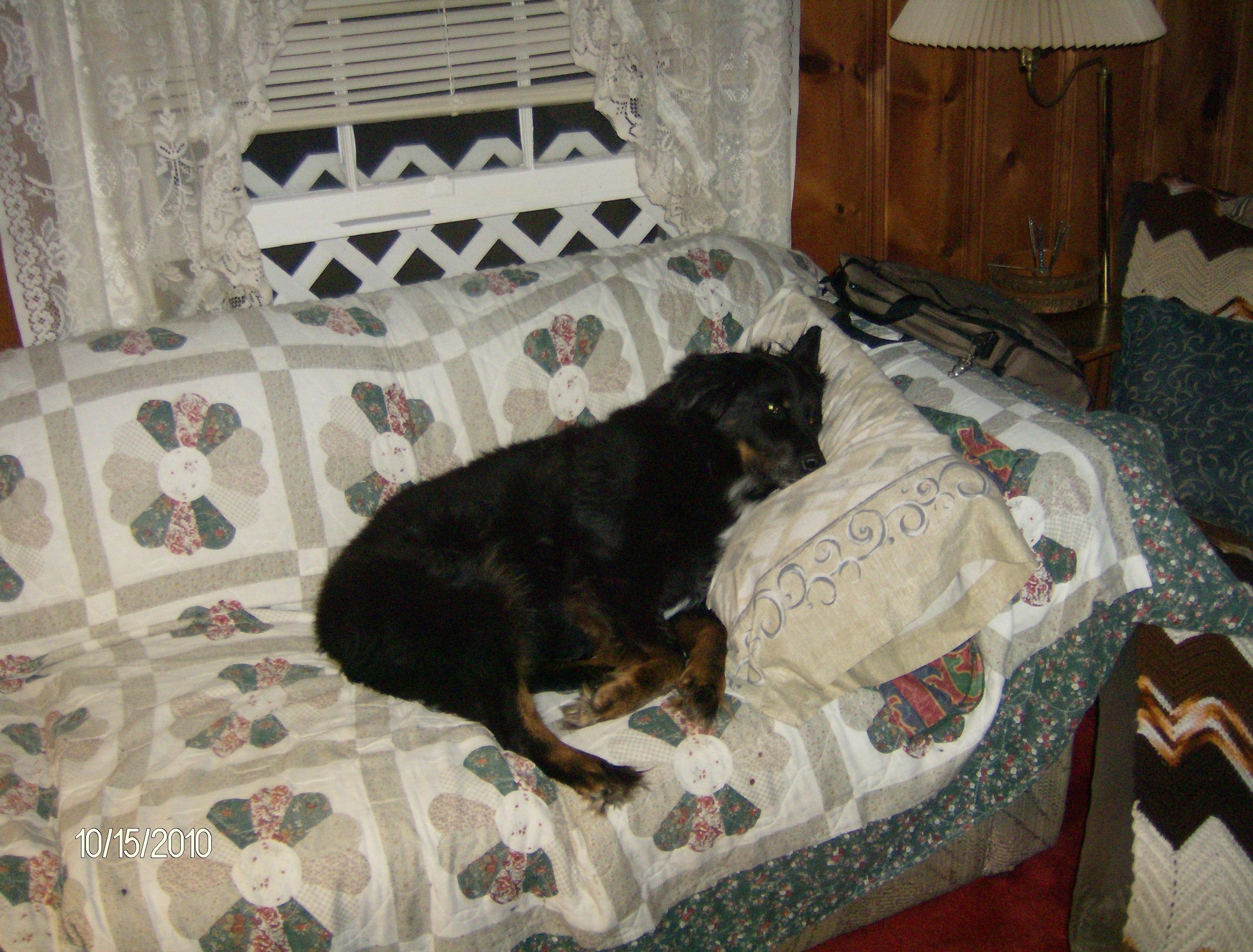
Rose.  She always loved to lay by a fan or ride in the air conditioned truck.

So I am hot...wanna fight bout it!

Toby and Rose lying under the kitchen table…..

Image

Sweet old Maggy

Image

When Rose got here she was housebroken and ever the lady and only wanted some attention and affection.  Maggy was head of security at that time and Rose became her back up.  Maggy would sound the alarm and Rose had a camouflage of looking intimidating….but she loved everyone….

She was the first dog I ever had who liked to play with mice like a cat.  She would catch them and then lay them between her outstretched paws and let them try to run away so she could catch them again….fully half of roses Mice escaped unharmed by running under her and out the back when she stood to look for them.   Little Lore used to hate that….she was an intense little cattle dog and thought it foolish to play with mice.  If one escaped Rose, Lore would grab it and quickly dispatch it.  After Lore was gone Rose taught both Toby and Later Dee Dee this game.  Dee Dee had a mole just last week….

This trick brought Rose the only calamity she ever had with us.  She was hunting for mice and ended up Snake bit by a copperhead.  Her head swelled up like a basketball and we took her to the emergency clinic and they pulled her through…

I spied and got the offending snake about two weeks later and had to turn over a 100 gallon water trough to get him but he got his just deserts…..

For years Rose was my nighttime foot warmer….when I got on the sofa and turned the tee vee on as soon as I put my feet up Rose would jump up and lay her head on my legs….she would lay there as long as long as there was a hand on her….

Rose was a lot like my first Aussie, Monte, and I used to tell her that I thought Monte had sent her to look out for me and she would just look at me and lick my hand as if to say “Of course he did, silly.”  When Loreal passed away both Maggy and Marie took it very hard…Lore died in the bed sleeping not far from Marie….And Marie picked out Toby to take up the slack.  Maggy adjusted and accepted Toby, but he became Roses Dog.  We are crazy people….even our dogs have dogs….Then years later when Toby passed away and Devil Dog Dee Dee came here she was adopted and raised by Rose.

In advanced years Rose would lay in the floor and wrestle and play with this bundle of fur and teeth….Dee Dee would grab Rose by the collar or her ear or her neck and just run along side her, as Rose always accompanied me on evening chores.  Rose accepted this and it carried on to the end…As Rose got older and more infirm we tried to stop the behavior in Dee Dee but she had difficulty changing and finally came to understand what ‘don’t hurt her’ meant.

Like all our aussies Rose loved to ride in the truck….didn’t matter where to or how far…she just wanted to ride and preferably with her head in my lap.

About two years ago we found some lumps on Rose and took her to the vet….They gave a grim prognosis and offered to do several thousand dollars worth of exploratory surgery and chemotherapy on her…..with no promise of improvement.  I asked if she was in pain and they said probably not yet and that they didn’t expect her to go six months….Two years later she bagan to decline…A tumor in her udder blew up….not the one in her neck that they thought would take her out….but she was still vibrant and alive and enjoying life.  Then she began to slow down and other symptoms began to show….A daily aleve seemed to push back the pain and she was running and playing….then trouble urinating and discharges…..but she was still so happy and loving, just at a slower pace….last week her eyes began to dull and then Thursday she became extremely nauseous .  Marie called me to tell me how sick she was, so I called the vet and came home early.

Knowing this was coming and knowing how bonded Dee Dee was to Rose we had begun searching for another Aussie.  I had hit all the aussie rescue sites and then suddenly BARK right here near home had a registered Aussie.  We had not dealt with BARK and had to go through their application process.  We wanted Dee Dee to have some time to adjust….We got approved but not soon enough…..I could not have Rose suffer unnecessarily….

When I got home Rose came to greet me and put her head in my lap and wagged her butt feebly.  I asked her if she wanted to ride and she headed for the door….She spent her last hour riding in the truck with her head in my lap…I did okay until we headed home and I nearly wrecked the truck because I could not see.

On Friday I buried Rose, but I dared not let Dee Dee know because she was as distraught as I , and I am sure that if she knew she would have dug her up.  Dee does not like to Ride like the aussies, but she tolerates it….and she was by my side all day Friday and Saturday.

Saturday afternoon we got the new Aussie Apache and they are bonding better than I had anticipated.   But that is another story and I can already tell that Monte and Rose have sent this dog to take care of me and Dee Dee…..He is just a few months older than Dee Dee and I have already told them both that they have to outlive me cause I am not sure I can do this again.

SUNDAY BEFORE MEMORIAL DAY


Stewart and Dancehall Dixi and Palladin Perkins and I made a foray down to Pocahontas State Park on the day before Memorial Day 2012.

STEWART AND DANCEHALL DIXI

It was quite warm and the may flies have come out in numbers and the horse flies are beginning to be bothersome.  But we slathered on a good bit of bug dope for equines and rider alike and we pressed on.

I did find a small gathering of seed ticks settled in for dinner at the area where the top of my boot had been.  I put a little vicks on them, waited a couple of minutes and easily wiped them off.

Perkins is wearing a good coat of mineral oil with tea tree, cedar and peppermint essential oils mixed in.  Not a magic bullet but works as good as the twenty dollar stuff.

THERE IS A TWO TREAT FEE FOR MY IMAGE

This was our first trip to Pocahontas.  Since it was a place neither of us had been to and it is not too far away we figured we owed it to ourselves to visit.  Easy to get to once we get to an interstate.

We found nice broad trails that would be well suited to driving horses as well as riding.  Most were graveled or sandy or had crush and run on them.  Most of the ones we rode were thru the woods and so they were shady and cool.

Most streams were culverted and there were a couple of nice wide bridges.

We only saw two other horses but did see a few hikers, joggers, dog walkers and bicyclists.  All were handled with aplomb by both riders and mounts.

of course below was our usual view of Dixi,,,,

OUR NORMAL VIEW OF DIXI

That little mule walks like a big walking horse.  She does not take big steps but she takes a lot of small ones .  She just scoots right down the trail without being in any hurry at all.  Perkins and I were either trotting to keep up or Stewart and Dixi were waiting for us.

JUNIORS BUG HAT FITS OK

Perkins gave Dixi Juniors old bug bonnet.  Fits her okay.  Ears are a little long but they were long on Junior too.

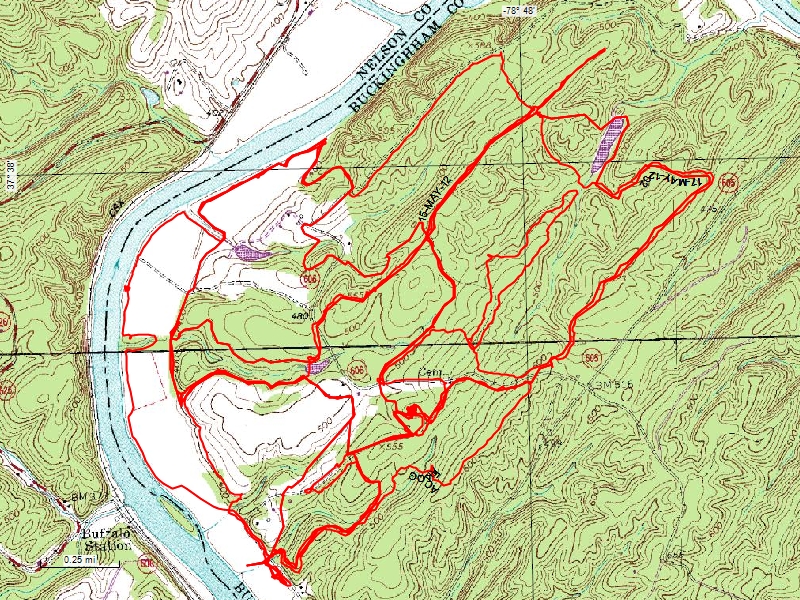
We only rode the southern side of the park.  there are supposed to be a lot more trails on the other side of the road but by the time we had done the 7.83 miles and came around to the trailer we were all ready to cool off and go home.

We had our usual good time and all came home safe and sound.  Goodness knows the Va State Police were out there doing their part to keep us all safe.  And they all had plenty of customers.  blue light specials every couple of miles..

MY VACATION AT JAMES RIVER STATE PARK


This may sound silly to some folks.  But I took a vacation.  At 63 years old I took a week off from work and went somewhere I wanted to go to do what I wanted to do for the first time ever.

I have scads of vacation time built up….in fact I lost some this year because I did not take enough time off, even though I take most Fridays off.

But old habits die hard.  For the last 25 years or so I have taken the week after Thanksgiving off and it gave me about eleven days at home to synchronize the cow herd and try to get an AI service on as many of them as possible.  My vacation week was the hardest working week of the year for me as I put the whole herd through the chute multiple times during that long week.  In addition I was with the cows 18 hours per day checking for heats to determine when to breed each cow.  Not complaining….it was work I enjoyed and was pretty good at.  Cows, horses and dogs have been a big part of my life ever since I can remember.

We sold the cow herd nearly three years ago now and for the last two years I don’t even remember if I took a vacation because I only have three pet cows now.

But last fall I took a Memorial Day weekend trip with Stewart to Stem North Carolina for a big fund raiser ride. That report is elsewhere on this blog.  We had such a good time that we planned on doing it every year.  Alas that ride is no more for reasons unknown to me.

So quite a few months ago Stewart came up with the idea of going to a park and camping and riding.  Originally a bunch of us guys were going.  James River State park was selected as the venue.

http://www.dcr.virginia.gov/state_parks/jam.shtml#trails

A date was appointed where all four of us were available and Stewart started making reservations.  I announced in a January staff meeting that I had put a week of vacation on the staff calendar during the month of May and half of my coworkers nearly expired from shock.  We managed to pull them through it without any long term effects.  Although one refused to believe it and was still e-mailing me about appointments and calls this week as late as last Friday.

We actually only went for three days.  I did chores around here prior to going and tried to make it easy on Marie to care for the stock while I was gone.  In the days when I travelled as part of my work Marie ran this place by herself with a little help from Jack, my late neighbor.  But when I started living at home and working locally, I promised her that I would try to hold up my end for a while so she could take a break.  Until last Memorial Day weekend I had only missed two days in 16 years of doing the daily stock chores, and both of those were days when I had a surgery and was knocked out in the recliner.

But it was three days that matched our anticipation.  By the time we left, the ranks of attendees had been thinned to just Stewart and I.  But Stewart had declared that if he died he wanted his hearse to drive through the place before he was interred.  I was just about as resolute, but too cheap to pay for the extra hearse ride.

We had been planning and stockpiling goods since the inception of the idea.  Stewart is a veteran camper and had a lot of gear.  Not camping much since my retirement from two years of olive drab, I had only the essentials.  As certified old farts we both had Doctors appointments on Monday.  Mine was my quarterly Rheumatoid Doctor.  After the doctors we met at the local Walmart and we purchased the perishables we needed for the trip.

We were going on vacation and we figured there was little need for us to go to a distant and foreign place and impose suffering and hardship upon ourselves.  We planned on riding, fellowship and fun and good meals.  To that end we bought double redundancy in food supplies.  We had a week’s worth of supplies and planning and we had to try to eat it all in three days.

The weather forecast was not favorable…..but we decided that neither us nor the horses would melt in the rain and as long as there was no lightening we would ride and feast.  We set out undeterred Tuesday morning.  The drive was uneventful with little discourse as we were both driving and pulling our own trailers.  About two and a half hours later we turned in near the James River and it was up in flood and rolling and roiling muddily.  I knew there was a trail along the river and I hoped it was not under water.

Upon arriving at the check in our reservation packets were there waiting on us although there was no one at the station.  We found the designated camping area and pulled in to see it totally vacant.  Stewart and I got out and looked around and studied our paperwork and decided that there was no assignment and we selected where we wanted to set up the trailers and where we wanted to stable the horses.

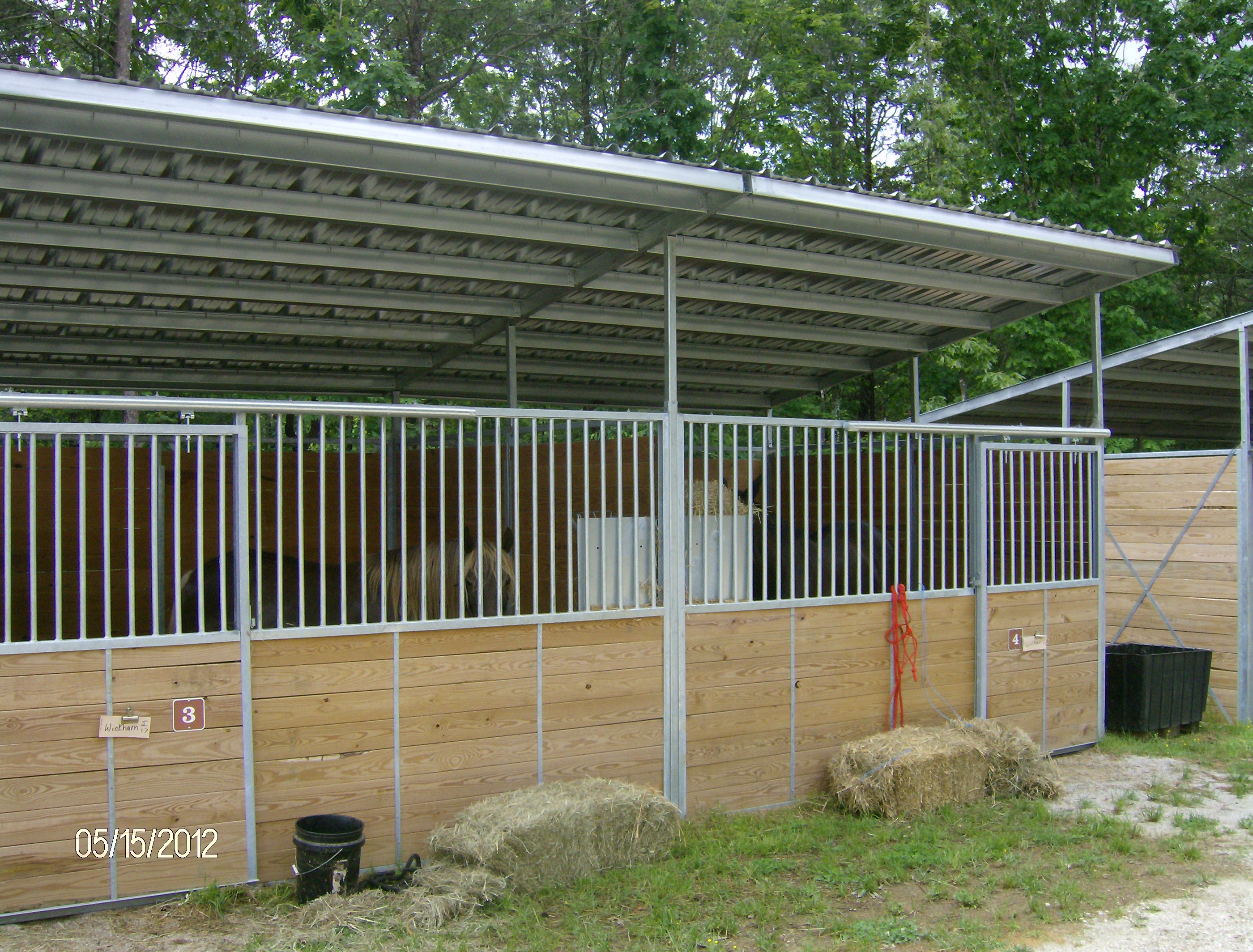
We were impressed with the facilities, both human and equine.  The camping sites were nice with power and water at each site along with a permanent fire ring with a grill and a lantern hanger and picnic table.  The stalls were fabulous and Perkins came to love his, even though he did not like being shut in there alone at first.  Here at the Poor Farm, the horses have separate stalls, but they can see and reach each other.  There, the walls were at least seven feet high and Perkins could not see Loretta and that bothered him a little ……until I gave him some hay and grain.

Bathouse was as nice as it looked.

The stalls were very nice.

We went about setting up camp.  Did not take long as Stewart is an old pro and has a penchant for organizing things and has a methodology and a routine.  All I had to do was try to follow  directions.  Pretty soon we were set up and decided to have a little lunch and try to go for an afternoon ride.  We had a nice lunch of pre-prepared foods and soda.   Then we tacked up the horses and rode out.  The rain had held off and the skys were rolling clouds in and out but we decided to chance it.  Turned out we had a beautiful ride and it did not rain until after I had crawled into my blanket in the van.  Rain on the roof put me right to sleep.

The trails were absolutely beautiful.  There are three albums of photos from this ride at my webshots photos site and they are on my wall at facebook as well.  The albums all start with James River State Park and one is trails, one is facilities and the third is bill of fare.  All of these photos need to be viewed in large format to truly see the beauty.

http://community.webshots.com/user/pdfangus

https://www.facebook.com/pdfangus

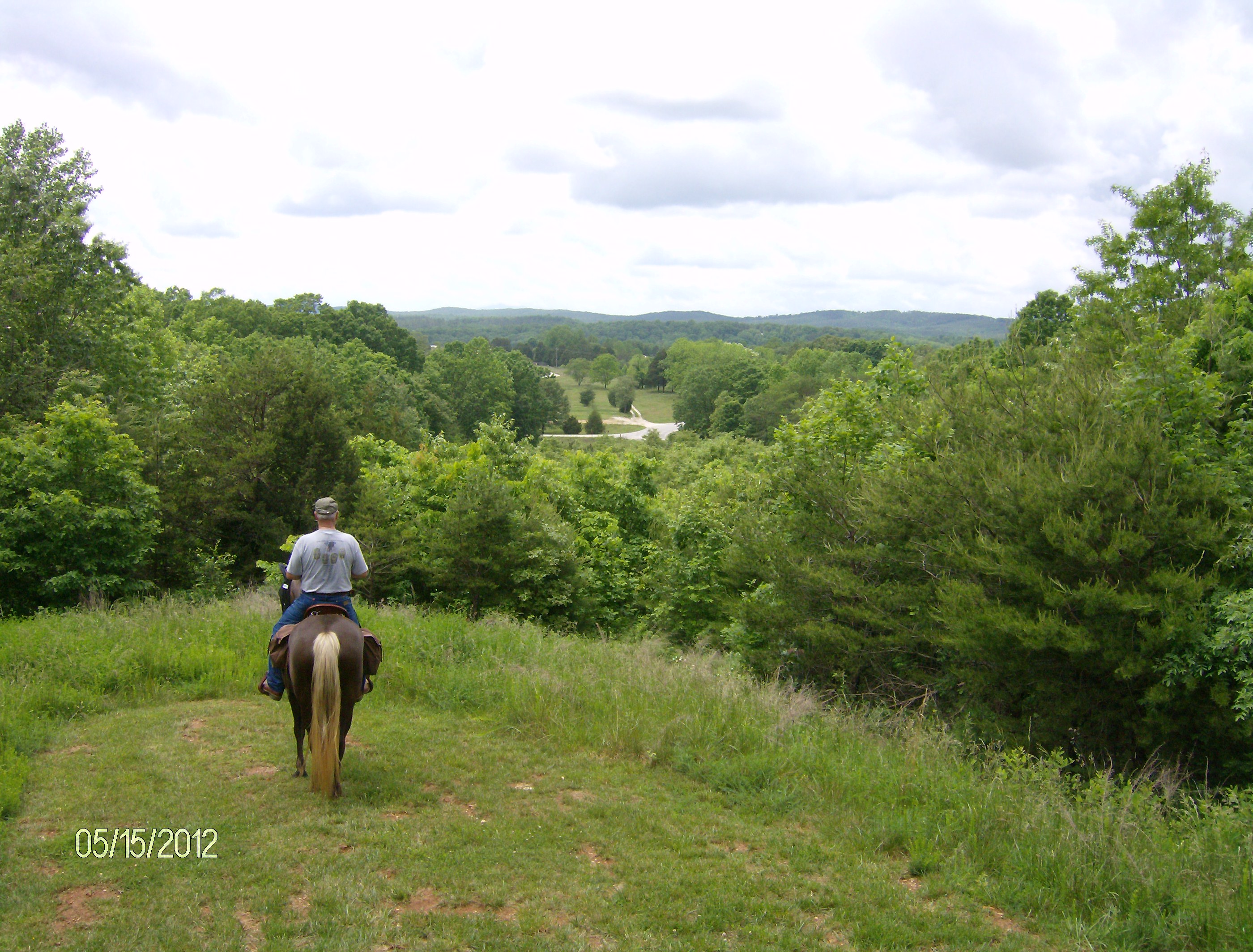
The terrain is varied from long flat level stretches of nice wide trail to curling descents and inclines and most of it is through beautiful southern hardwood forest.  I was surprised to find more than a few white pines interspersed through the forest.  When we were on the Branch trail in particular the air was fresh and fragrant and I never did discover the exact source.

The first afternoon we rode the southwestern part of the park and managed to make our way to the river trail and hoped that it was not under water.  At Dixons landing we encountered some folks who were actually trying to fish in the roiling river.  I don’t know if they were successful or not but the river was way up and rolling on by.  Fortunately the river trail is high enough that it was not flooded and we embarked upon it.

Long flat ride of nearly three miles right along the river for the most part with alternating grass land and marsh on the other side.  A soaring eagle watched us for a good part of the ride.  Close enough that we could see his white head and tail as he circled above us and the river and marsh.  We rode 6.54 miles and found our way back to camp.  We hosed off and cared for the horses and put them in the stalls.  Perkins went to munching hay and took a good drink of water.  That was a relief because Perkins is usually finicky about water and on day trips seldom drinks til he gets home.  Marie says it is because he is partial to the pond water pumped in fresh daily here at the Poor Farm.  We have a solar pump that pumps water from the neighbors pond to storage tanks here for the livestock.

We washed up a little and then began supper preparations.  I think Stewart and I both surprise each other at how well we cooked and managed to get things done together.  For the first evening meal I grilled Steaks and made a fresh garden salad with mixed lettuce I grew here and Stewart fixed potatoes with butter and sour cream and chopped up green peppers and onions for the salad.

After a nice meal we cleaned up and put away and tried to bear proof things.  Checked on the horses.  Got Perkins some more water and hay and then after a nice shower, I hit my air mattress and crashed and burned to the sound of gentle rain on the roof of the van.  Stewart said he was wakened about 3:00 AM by the horses making a fuss.  He went down and checked and all was in order.  I never heard a thing.  I woke about four and turned over and went back to sleep until it started to get light.

Stewart started coffee and we tended the horses and then we got some fires going.  Five cast iron frying pans and one boiling pot can generate a good breakfast.  Omlettes, country bacon, fried potatoes with peppers and onions, fried apples, toast and sausage gravy and plenty of hot coffee.


After this lumberjack breakfast we cleaned up and stowed stuff and tacked up and set out for a morning ride.  Perkins had consumed at least seven and a half gallons of water during the evening and morning.   Our plan was to ride a few miles and come back for a light lunch and give the horses a break and then ride off again.  This is what we did and we had a nice morning ride on more beautiful trails.

The weather was beautiful and there were no bugs to bother the horses or the riders and we had a delightful ride.  We rode six or seven miles in the morning before finding our way back to camp.  Along the way we found a pretty little mountain stream and Perkins had a big drink of water.  This is something he never does, so my worries about him drinking went away.  We untacked and hosed the horses off.  I put Perkins hobbles on and just let him graze.  We had a light lunch and relaxed for an hour or so.  It was so peaceful to have practically the whole park to ourselves.  We ran into a couple of rangers a time or two and they said that on weekends the place was packed and that we had picked a good time to come.  We ran into a few guys doing maintenance and construction work.  We thanked them all for their work on this beautiful park and told them how much we were enjoying it.

We rode back out and did another six or eight miles in the afternoon.  I am guessing at the mileage by breaks but know we did 14.54 miles on Wednesday according to the GPS.  Stewart and I are not speed demons and we enjoy just ambling along and enjoying the beauty and seeing the sights and talking a bit.  We saw numerous deer, about a thousand squirrels, tracks from all kinds of wildlife.  We did not see any signs of bear.  But at one point the horses tensed up and were watching to the left and we did not see anything.  But there was a loud crash in the woods that sounded like a tree falling.  We concluded that it was sasquatch and had a light hearted discussion of, if we saw him should we shoot him.  After a discussion of laws and regulations and possible legal actions, we decided that if we could drag a dead sasquatch out of the woods it would be worth it.  That is just the kind of silly fun we have when riding.  We might retire and become professional sasquatch hunters.  We can not do any worse than the existing sasquatch hunters.  No one has found one dead or alive yet.

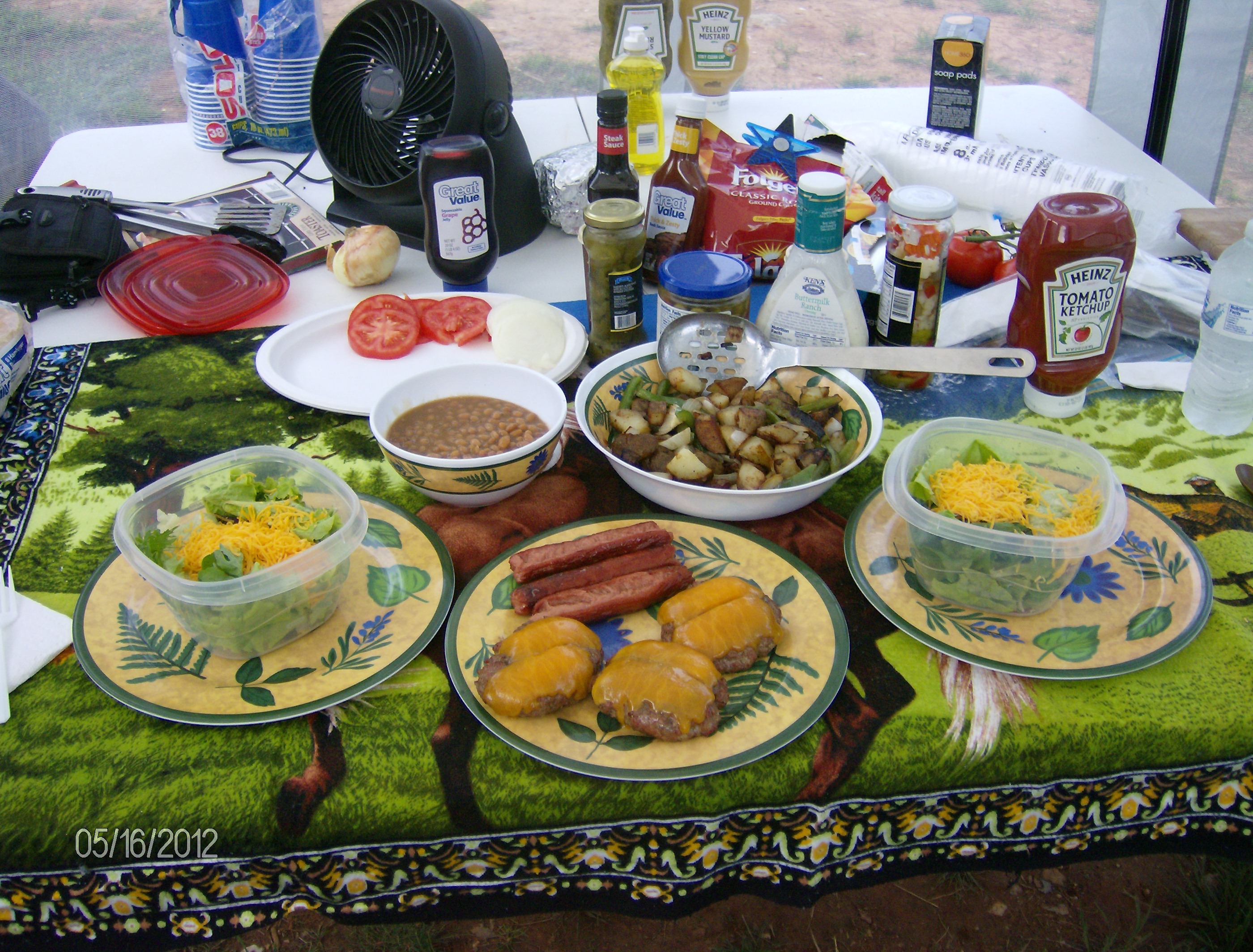
Arriving back in camp we went through what was becoming our routine.  Cared for the horses and cleaned up a little and then started some supper.  Cheeseburgers and Hot dogs with all the fixings, baked beans, fried potatoes with green pepper and onions, fresh garden salad with Kens buttermilk dressing and a couple of golden beverages.  That cheeseburger with good cheese and tomato and onion was delicious.

Clean up and stow the food.  Catch a shower.  Check on the horses again.  By now every time Perkins sees me even glance in his direction he is nickering at me to bring him a treat or some grain.  Old boy knows an easy mark when he sees one.  Then we made a campfire in the fire ring mostly to burn the burnable trash and a few sticks that Stewart had been shaggin back to the fire ring with every foray outside the camp site.  We sat and chatted for a while until the fire made me so sleepy I nearly fell out of my chair.  I hit the blankets and was down for the count.  I awoke once during the night and listened to see what had awakened me.  Hearing nothing, I rolled over and was gone until first light.  Stewart was already up and fussing with a crow that had perched over his trailer and awakened him with its cawing.
Checked on the horses and Perkins started nickering as soon as I emerged from the Van.  I don’t feed in the morning at home, but it did not take him long to acclimate to two meals a day.  He tried to hide it but I could tell he had laid down in the stall that night.  He had some flakes of shavings stuck in his sparse little mane and a few on his belly.

Breakfast the first day was so good that we did the same thing again the second day.  It was even better because we remembered to slice a tomato for breakfast.  We had a hot dog left over from dinner so Stewart sliced that up and added it to the morning potatoes.  We did not have any sausage gravy the second day.  We had sausage but decided that too much of a good thing might spoil us so we just finished off the bacon.

After enjoying another feast and while we were cleaning up and breaking camp, I threw down the gauntlet for Stewart.  I said that when we do this again we have to come up with some different menu items so that we would not be one trick ponies.  All morning and ever since we have been discussing future culinary possibilities.

We decided to strike camp and have most of the stuff ready to go.  Then we could take a morning ride and have a light lunch and then head home.  We put away most of our stuff and packed up.  We figured out what we would have for lunch and fixed it and so that all we would have to do was pull it out of the cooler and eat.  We got packed up and then tacked up and rode out about 9:30 or so.  Guessing at times as my cell phone did not have a signal and I use my cell phone for a watch.  Stewart is on Verizon and he had a good signal.

We rode nine miles and it may have been the prettiest day of the three.  Mild temperature, nice breeze, no bugs and back on the beautiful trails.  What was interesting is how much the horses bonded with us during the short stay with close association.  Perkins seemed to not be just looking for treats.  It seemed he actually enjoyed my company.  Given the choice he would rather hang out with Loretta but he liked me too.  Being home today he has nickered at me several times and after he ate supper tonight he came and put his head over my shoulder.  Stewart says that Loretta has been the same way since he has been home.  Maybe when we retire and become professional sasquatch hunters I can spend more time with my horses.  Marie suggest that any more time and I will have to move em in here with Dee Dee and Rosie.

While we were eating our last lunch, we turned the horses loose to graze.  I put hobbles on Perkins just to be safe.  We thought Loretta would stay with him.  We had already cleaned the stalls but left the doors open.  We spied Loretta going into Perkins stall and Stewart went down there to get her out and Perkins was in there as well and they were both munching on hay I had left in the rack.  Perkins had not seen Loretta in over three months, I would guess, but the two of them are fast friends.  I told Stewart it looked like she was going to have to come live at my house.  He didn’t think it was too funny….

Got home and Marie had some excitement as well.  There had been a big black snake curled up beside the house.  Marie was trying to keep miss nosy Dee Dee from fooling with it and hurt her back picking Dee Dee up to get her into the house.  Marie said the snake was as big around as her arm and she was afraid it would hurt Dee Dee.  I am on stict orders to be on snake patrol now and the dogs must not be let out of sight.

Dee Dee and Rosie did miss me.  When I was walking down the Driveway from putting Perkins in the pasture, Marie let the dogs out to greet me.  Dee Dee was a black streak running down the driveway to me.  Rose was trotting along behind after she howled her welcome home howl.

It was a great time with a great friend, at a beautiful venue with beautiful weather and good food.  Nothing busted.  No tragedy befell us.  Everything went just like we hoped.  Some have opined that it is as close as I am likely to get, when I say it was like three days in Heaven.

Baby Jim The New Puppy


  Photo courtesy of The Old Cowboy Archives

                 The New Puppy

  A  few weeks ago now we lost Marie’s little dog Toby.  Toby was supposed to be a miniature Australian Shepherd, but Baby Jim’s own theory was that he was a cross between a nomadic wanderer and Sylvester the cat.  Toby was a rescue dog that came to the Poor Farm from Georgia via Aussie Rescue.  Marie saw his photo and that was the dog she wanted.  It was up to Baby Jim to make it so.  He did and Toby became an erstwhile member of the Pipe Dream Farm staff, eventually. 

 Toby spent the first year or so with us trying to find a way to get to Pittsburg or some other foreign and exotic locale.  For a long time to venture outside, he was required to be on a leash as unfettered he would simply head down the driveway and take a left on Old Ridge Road.  As an Alternative he would sometimes continue straight through the woods and cross the Smith Farm and as a breathless Baby Jim pursued alternately calling and cursing,  Marie would drive around to Coatesville Road and pick him up there.  It was not that he didn’t care for the hospitality of Pipe Dream Farm.  He just had places to go and things to see.  Baby Jim said he apparently had the wanderlust gene.  The folks who had fostered him before his arrival here said that they had experienced several explorations of the far flung reaches of their suburban neighborhood.  He had originally surfaced in a pound somewhere in Georgia after being picked up for vagrancy, with eye problems and a full complement of worms including heart worms. 

 In later years, Toby had better resisted the urge to leave.  He had become comfortable with sleeping on the bed and eating regular and he learned that Marie was a soft touch for treats.  He would occasionally look down the driveway but apparently gave up on his quest to see Tahiti.  He would however take out after the hounds that run 365 days a year in our locale.  If Toby spied them he was off to drive the marauders away from his home with 25 lbs of vicious intent.  Baby Jim does not think any of the hounds ever noticed the danger they were in as they continued their single minded quest in pursuit of the quarry of the season.  Apparently something is always in season here, because the hounds go on forever.  This weekend it has been the spring fox hunt with nary a horse in sight.  Just hounds and pickup trucks.  It was supposed to be Thursday and Friday and Saturday but it started on Tuesday and dogs will still be alternately on the trail and looking for something to eat, sad looks, anything really, can you spare a quarter, have you seen my truck?, for the next week.  

 But we digress.  Toby fell ill.  At first it was occasional incontinence for which he was always ashamed.  Pretty rapidly the lethargy set in and then he lost his appetite.  Marie would cook chicken or beef for Toby and shove a nice TV dinner in front of Baby Jim.  Finally he (Toby) quit eating and was in obvious pain and Baby Jim took him on that last ride in the truck.  The young women in the Vets office were somewhat unnerved to have an ornery looking 250 lb old man standing in their midst with a little dog in his arms with tears rolling down his cheeks and barely able to speak.  Thankfully Toby was not aware of where he was, he hated the vets office, and soon it was over and he was interred with the great company of those who had preceded him here.

 Baby Jim missed the little rascal terribly but was glad that he no longer suffered.  Marie was heartbroken.  Even Rose went through a grieving process but she did benefit from the increased attention and not having to share her people.

 Eventually Marie started dropping hints about a puppy.  Baby Jim had become accustomed to the dogs that came here with a layer of civilization already installed.  There has not been a puppy here since Maggie came to live here.  Maggy was a shy and quiet type and she had Lore who was a year or so old at the time to raise and train her.  Our Aussies have always raised and trained the young ones.  Maggy grew to be an 85 pounder who was as meek as a lamb unless she thought one of us needed protecting.  She lived a good long life with us and we buried her in 2008. 

 But…… then someone, whom Baby Jim previously had thought to be a friend, called and advised him of an Aussie Puppy in the local pound.  Baby Jim stopped by on his way home from work.  For one who has been thought of in many areas as a mean old SOB, Baby Jim does not do well in that environment.  A hundred dogs in cages all clamoring for their people, or any people, or just a little love and attention.  He tried hard to shut it out and not look at the faces…….Then the lady opens a cage and deposits a black ball of fur that is all feet and tongue and energy and love in your arms.  Once you have your face licked and your arm peed on you are pretty much committed.

 A few minutes later, Baby Jim opened the front door of the poor house and put the pup in and closed the door and went out to retrieve his gear from the truck.  He returned to the house to find Marie with her face buried in dirty stinky pound puppy hair.


Even though on one on earth knows what this mutt is…..she can pass as an Aussie as a puppy…… and there might actually be some little bit of Aussie in her pedigree but it is too late to care.  She is more likely a cross between a starving hyena and a manure spreader.   Nothing is safe from those needle teeth.  Not shoes or pants legs or even poor Rose.  Rose is such a great dog and accepted this new trial with grace and aplomb.   She tolerates the chewing, and jumping and stealing and wrestling and outright adoration.   Right now there is a large black fuzzy dog lying by the feet of Bay Jim and nestled up to that is a small black bundle of fur, asleep thankfully but chasing something in her puppy dreams.

 Her name is Dee Dee and she knows her name already but often still chooses to ignore those who don’t use it appropriately.  She must be kin to Marie as she is strong willed and determined to do things her way.  But unlike Toby, she took all of five minutes to claim title to her new address.  She is still exploring her new realm and finding new things to chew on.  She knows what “NO” means but has serious backslider tendencies.  She knows the kitchen counter is the source of Maries Treats.  She knows she has to sit to get a treat from Baby Jim but will snatch one out of Maries hand in an airborne leap of unbridled enthusiasm.  Rose can still seek refuge by getting up on a sofa or her table bed by the window.  But only because Dee Dee prefers not to get up there.  She can jump up because as Marie was doing dishes one evening she found that Dee Dee had jumped up in a chair and onto the kitchen table to make sure Marie had cleaned everything off.  Maries solution is to warn and chastise Baby Jim to push the chairs all the way under the table.

 Baby Jim is too old and infirm to run and play with her.  Mostly he fears that he will step on her or take a fall trying to avoid stepping on her.  Some think a fall has already been narrowly averted, but he aint talking.  He has been observed lying on the ground wrestling with her however.  Dee Dee is still not a big fan of truck riding, but she does not get car sick as so many puppies do, and she is going wherever her Rose goes, and Rose loves to ride and is also happy that she can now once again lay her head in Baby Jims lap to be petted in transit.

Into the 20th Century


We have finally joined the twentieth centuary here at Pipe Dream Farm.
Of course it took us 12 years into the 21st century to do it but that is the price we pay for living where we do.
The major step we took is that effective today we have DSL at the house.
I got it hooked up today and it is nearly as fast as what I have at work and I only signed up for the slow speed.
I still do not have it competely registered but it is working as evidenced by this post.

When I try to register it gets to an error page and it tells me to call customer service. I did yesterday and got put on hold so long that I finally was disconnected by the robot. I figure I will wait til next week when some people come back to work from the month long vactation of ThanksChristmasYear.

The thing is working, and that is what matters to me. Of course just getting it was an adventure in and of itself. I got a card in the mail a while back that said internet service was available from the phone company. Checked on the computer and sure enough it said I was eligible. Saw a phone guy working at the switch box on the corner a mile down the road and asked him and he figured out that I was eligible. There are only two other houses between me and that switch so I figured no way I could get service. The guy told me that I was on the edge but that it should work okay.
So far it is great. Boss says wait til I get the bill before celebrating……

I ordered it over two weeks ago. Then few days later a guy came to the house and did something on the box outside and told Marie we should be good to go. yeah right.
he was assuming that I already had the DSL modem which was supposed to be shipped.

I called centuary link and told them I had no service. the guy started asking questions about the modem….
I told him that it would be easier to answer his questions if I actually had one…..He told me when one had been shipped…..I told him I did not have one….

He said I will ship you another one. waited a week and still no modem….called again….another guy tells me that records show we have shipped you two and that one has been delivered…..

I asked him if he could explain why I was calling then? He apologized and said he would overnight one.

Yesterday two were delivered by UPS and I refused one and took the other…. don’t know where the third one is……

but anyhow I am now able to use the computer at home again….
Of course the laptop just lost its portability…..as that is what is hooked up.

A poor boy can’t win for losing.

Still battling the ribs….yesterday was pretty rough….today has been pretty good….but then the only thing I have been allowed to do today was unload three hundred lbs of cattle pellets and the supervisor was right there telling me how to do it…..It does not hurt to pick up a bag of feed or a bale of hay as long as I go slow. It hurts to toss a pad of hay. Had the boss doing that today. It hurts to push a button on the car radio or adjust the heater controls or reach in certain directions. I can push myself like when rising from sitting or standing but I can not reach out and pull. I will turn loose quick.
Spent the rest of the afternoon hooking this thing up and quasi watching football and napping on the heating pad.

Yesterday I had about decided to relent and go to the doctor….I did call them the other day and they said they did not have an xray tech on duty and to go to the ER. I am not going to the ER for something that happened two weeks ago. I don’t have an emergency….just a pain….If it had punctured a lung of a bowel or a kidney, I would be dead by now so I don’t think it is any of those…..I think I just tore muscles or cartalidge…If I can keep from sneezing it should be okay.

I am reluctant because last time I hurt the ribs I spent several hundred bucks for them to tell me sorry charlie, they just have to heal….Not much we can do for broken ribs…….Then they had me spend several hundred more dollars to chase phantom spots on my lungs with multiple xrays and finally an MRI, which all turned out to be nothing….Doctor enrichment and milking the insurance system to drive up my insurance costs and yours too….

Was talkin to my cousin today. he went thru college on a football scholarship. He was much faster than I was……I said I don’t know how some of these guys play after a couple of weeks with busted ribs…..He laughed and said they don’t feel anything….on game day…..makes me glad I was slow….I wrecked my body enough without doping it up to wreck it more…..but then I guess that is the price of fame and glory for those guys.

A man oughta do what he thinks is best….John Wayne as Hondo Lane
Jim Tate
pdf-angus.att.net
Delete ReplyReply ForwardSpamMovePrint Actions NextPrevious

3. MANAGEMENT INTENSIVE GRAZING EXPERIEMENT


Wednesday 4/21/2010
I began my cattle grazing experiment this past Sunday. Should preface it by saying that I am also using the cattle to clean up the horse lots behind the horses. The cattle on Sunday get the horse lot used during the week.
We are having a crazy week so I have not had time to take photos and document as I would like but will share some observations.
Grass has been slow to grow this spring. Barely reached ten inches at the target of beginning to graze.
Opened the first strip Sunday evening. Three cows just weaned and one bull.
Monday evening it was grazed as if it had been mown and the cows saw me walking to the area and heads went up. A simple call and they came to go to the new strip and the bull led the way.
Tuesday evening the next strip was again mown pretty clean. They left a few buttercups which are apparently pretty foul tasting and reputed to be a bit toxic. Buttercup invaded my place over the last two years and I am still figuring out if and what I want to do about it. The lot currently being grazed is mostly fescue with some clover and seedling vetch and seedling ryegrass.
Went I went to the area the heads went up and the cows called to me and started coming. Sam again was the first thru the new strip.
I walked the strip just grazed. 66 paces long and four paces wide. Roughly 165 feet by 12 feet or 1980 square feet. In walking that strip I counted 18 new manure spreads. Now my cows are not confined to the strips and still have access to the barn and to the main farm
lane and the water lane and shade in the trees. Still I think they spent a lot of quality time and left more manure in the pasture.
I think I will have a difficult time getting the area right for a small number of cattle and rapid spring growth. My area right now is too small and they had grazed it fairly closely, but grass is beginning to grow faster so more grass will mean less area needed so I may be in the right ballpark anyway. My target it to try to give them about 2000 square feet daily. I think by next week I will be close to right.
I eagerly await to observe the regrowth. Was hoping to take photos over the weekend but have to go to Roanoke for a funeral on Saturday and have to dig up a plumbing leak and try to get it fixed on Sunday.

4/22/2010
just a brief observation from last nights pasture rotation.
I changed strips at about 6:30 pm. The cows and the bull came running when they saw me go to the area. 4th day and they are looking for me to open a gate and the bull was last and came running. 1800 lbs of bull even if he is gentle gives you pause as he gallops by you to the fresh grass.
old strip had nineteen manure splashes/piles but they were mostly in the shady end of the field. Heavy fescue over there and it had not been grazed severely.
When I went in to the house right before dark I glanced down to where they were and they had already stripped enough grass that the area had changed color. I think there was grass left but in an hour and a half that had harvested a lot.
hopefully I can work half day Friday and get some photos.
Saturday is Memorial Service for Maries Brother and Sunday have a dig up the yard plumbing project.
4/23/10
Yesterdays strip was again pretty well picked over. Only nine new manure piles so I think they harvested it and went and laid in the trees or in the barn. The Mineral and the fly control backrubber and such are in the cattle stall area of the barn and they go there for shelter and sometimes for shade.
They saw me heading for the area and were there when I got there to open the new strip. I am going to try to set up four new lots this afternoon and plan to make them a bit bigger. They will be harder to measure as they will be more irregular in shape. I think the cows are grazing below the 3 inch desired limit right now. The strips from Sunday and Monday are already showing signs of regrowth and recovery.
The next fields I will go to already have more grass than where we are which is different from when I laid out these first strips.
Should add, that I have not minded limiting them a bit at first for two reasons. One is we just weaned the calves and they need some time to dry off. The second is I wanted them to clean up the last of the hay in the hay ring. I looked at it last night and they have some left but I think they have eaten what they are going to eat. Think I will move the hay ring and close that field this weekend and let it begin to recover.

2. MANAGEMENT INTENSIVE GRAZING EXPERIMENT


MANAGEMENT INTENSIVE GRAZING EXPERIMENT

The tools and methodology

My intended method is to give the cows the amount of grass they can consume in one day and then move them off of that area and onto another days worth of forage. There are several management objectives in this strategy.

1. Increase grazing efficiency. By having less area to walk over and select from the cows should harvest what is available to them in the given area. They will still eat the chocolate first and leave the brussel sprouts alone but they will do it over a more concentrated daily area.

2. The uneaten part will be trampled down and contribute to the organic matter of the soil. By concentrating the cows on a smaller area the hoof action on the area is increased.

3. Hopefully we will somewhat increase the manure deposition on a given area. the challenge will still be to get the cows out of the shade in the summer time which is where they hang out and concentrate the manure.

4. Increase the rest time for the forage between grazings. The rest time, is when the plant recharges and builds root reserves. Continued grazing stresses plants and reduces plant species diversity. My ambition is to establish deep rooted and diverse forage plants that will improve the soil.

5. Leave and increase organic residue to contribute to soil building. This residue may be manure or uneaten plant residue.

6. Reduce chemical inputs and raise forage in concert with nature.

7. Increase plant species diversity. I wish to have a forage base that will serve us in cool season as well as the heat of summer.

8. Reduce usage of stored feeds. I want the cows to graze as mush of the year as possible and feed less (in volume ) expensive hay. Initial goal is to graze for 300 days once we begin. We certainly had 65 days of winter this year and I must be prepared for that and more.


I will not begin the formal grazing strips until the grass is ready. I estimate this will be mid April. I have a grazing stick and want the grass to be a minimum of ten inches tall before we begin grazing. I am carrying cows on hay until we get to that point. This will also coincide with the plan to wean the calves about the same time we begin grazing. The calves will have to be confined away from the cows for a couple of weeks and a couple of lots have been set aside for this. This will allow the cows to begin to put on some condition and be ready for calving again in September. They milked well and are a bit thin, but they are bred back . I have already laid out the strips for the first week. We will begin in the lot known as the corner. I am eyeballing and guessing at the strips and the first week will be a learning experience. Hopefully I will get better at estimating forage availability and need with practice. I made an educated guess this time and will adjust on the fly. Simplicity of layout is also a factor. I am pacing distances rather than measuring. this photo shows six lanes laid out across the bottom of the lot with each lane made by one strand of polywire. The leaves in the foreground indicate a small lot what has not been used since fall and the cows are there right now cleaning it up. I put them there to enable me to let courts heifers access the barn for herd health work without Sam getting all emotional.

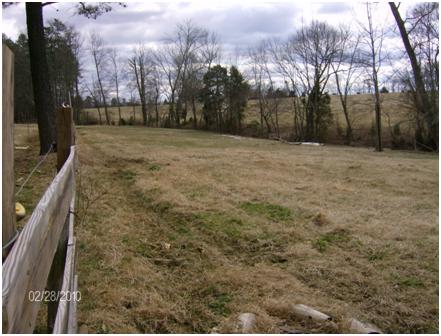
this is a view down the daily grazing lanes. The grass is currently 5 to 6 inches tall in these lanes. Clover is abundant with the wet year we have had.

This lot was broadcast with ryegrass and hairy vetch and lespedeza in mid March. However almost every lot has been broadcast with some sort of seeding so we have to start grazing somewhere.

The Ell actually has a bit more grass by volume but I desire to favor the bermudagrass out there and plan to take off the cool season grasses as the Bermuda breaks dormancy.


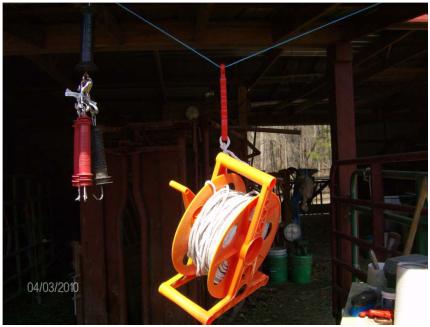
 this is what I refer to as an economy grazing wheel. The grazing companies sell nice metal and composite ones that should last a lifetime and they have hooks for hanging them up and they are very nice. They also cost about forty bucks each. This plastic extension cord reel cost less than eight bucks at home depot. This one has poly rope on it. I had a partial spool of poly rope. Most have 220 feet of polywire on each reel. 220 feet is probably as long a run as I will need to make, and the polywire comes on 660 foot spools. I put a no kick handle on one end so that I can unroll off of a hot fence if needed and rig up a regular handle with a double end snap on the other end so that I can quickly adjust and tension and hook up.


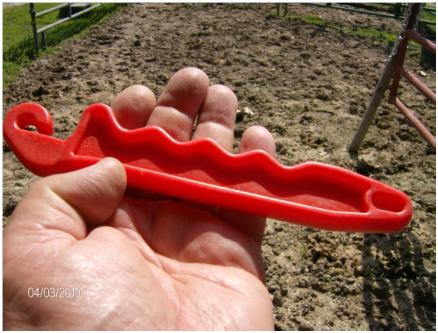
A no kick handle is a pretty simple affair. A piece of plastic with a hole in one end and a hook on the other. Since I have broken one already I may figure a way to make my own.


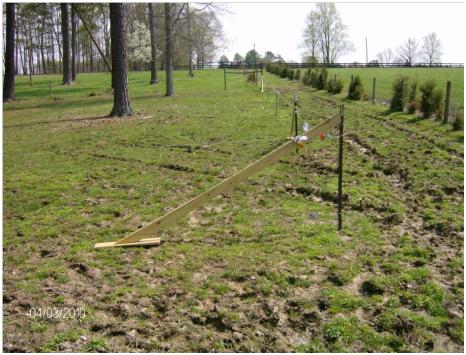
This is something neat I discovered on the Powerflex fence web site. It is called a floating brace. It is an answer to the needs of an arthritic old mans wrists. No need to tamp post or dig a hole to set a brace. Since I was only putting up one wire here, I cheaped out and used pressure treated 2X4 as the brace. For more wire a 4X4 would do better but other than that it is great. The foot is a two foot long section of pressure treated 1X6. I attached it to the 2X4 with a couple of screws. I attached the top of the 2X4 to the post with wire and tightened the brace with a fence strainer. The brace will bend the post.


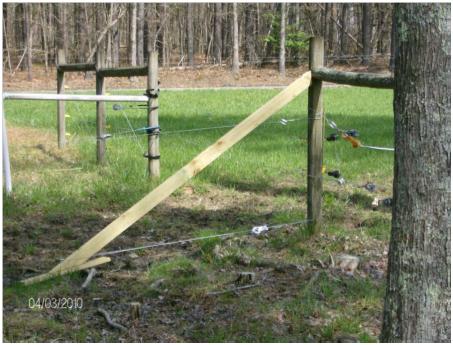
Works on a wooden post as well. This one is at a funny angle because the foot is actually sitting on a tree root. Should not sink in the mud. It is muddy in that spot now. The fence strainer is easier to see in this photo. One of the screws I used is an eye bolt screw and I ran the wire through the eye to prevent creep or splitting the brace.

 VDOT puts water on my property at four different points across my short road frontage.

We have had a LOT of water this winter and my place is still damper than most in the area. Star Baby loves to run and spray mud.


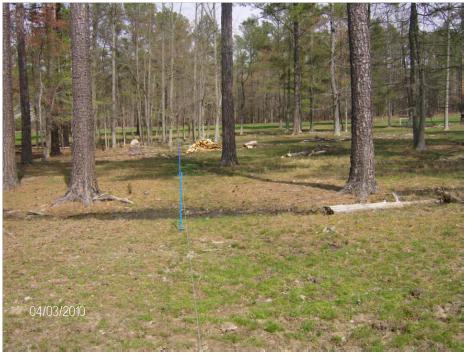
on the right in the photo is a new area that we fenced in and broadcast two weeks ago with rye grass, hairy vetch, lespedeza and some leftover tillage radishes. Just getting the horses off of it has started it to green up compared to left of the blue posts where they still are. The blue posts are Obrien Tread in posts. They are far superior to the ones in the feed stores around here and are no more expensive. They are made with a better resin and are much stronger.

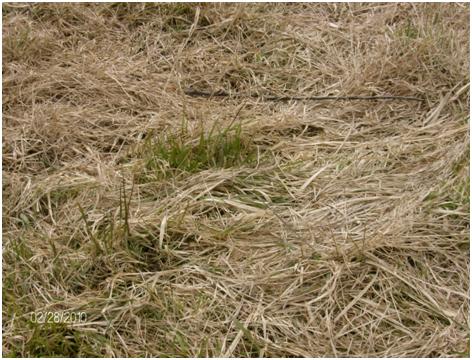
 The lespedeza is beginning to sprout …..Look closely in the track…….

The ryegrass and the vetch are not yet visible. Some of the tillage radishes seem to have sprouted as well. Could not get a good picture of them.

Aim to begin Grazing around Tax day  and will report more then.


PIPE DREAM FARM MANAGEMENT INTESIVE GRAZING EXPERIMENT


PIPE DREAM FARM
MANAGEMENT INTESIVE GRAZING EXPERIMENT

BACKGROUND INFORMATION

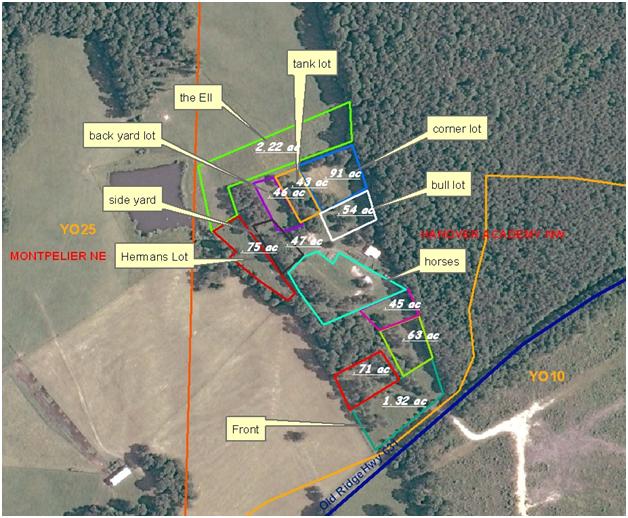
This is an aerial photo of my home, known to me as Pipe Dream Farm. For over twenty years my neighbor and I had a joint venture herd of registered angus cattle. He had the land and I had the experience and skills and we shared the love of the cows. The rascal came down with Cancer and thirty days after he was diagnosed we buried him. At least he did not suffer long. Two years later I miss him still. About that time I was diagnosed with rheumatoid arthritis.
Anyhow to make a long story short we dispersed the cow herd and I have a small hobby herd of three cows with calves now. We also have a couple of equines but they will not be a part of this study in any major way. They have their own area where they are rotationally grazed.
I have been practicing rotational grazing to some extent for over twenty years and have the place divided into small lots. In recent years I have subdivided lots using portable fencing. Every division gave me more benefit and ability to manage the land.
In January of 2010 I had the opportunity to meet Greg Judy and hear a presentation on how he manages pastures and makes money on cows and goats. This is no minor accomplishment.
I was inspired by what I heard and decided that the time was right for me to try to do better as well. My employer Hanover-Caroline Soil and Water Conservation District enables me to use this personal experiment as an educational tool as well.
I am working with JB Daniel, the NRCS Forage Agronomist, to do a case study and JB has already given me great guidance.
We are beginning by documenting the existing conditions.
The Ell is land that is actually owned by my neighbors estate but I still have the use of that acreage from the heirs. Similarly the paddock labeled Hermans Lot. Herman was Jack’s last Hereford bull before we switched to all angus. We built the lot for Herman to gain control of the breeding season and I housed and managed our bulls ever since and raised the heifers.

The Ell was last grazed in the fall of 2009 but after frost. We had a significant accumulation of bermudagrass over the summer when it was only lightly grazed. After frost the Bermuda was not prized by the cows and as a result a good bit of residue was left on the entire field.
This residue gives me a running start on the Judy management philosophy which is graze fast. Allow the cows to eat the chocolate and trample and fertilize the rest to add organic matter to the soil and move em on and rest the field.
Management intensive grazing is all about managing the grass and the organic matter and allowing proper growth and rest.
This field was last fertilized with bioisolids in the fall of 2008. This field is still permitted for biosolids and we anticipate another application in the fall of 2010. This is the only part of the project that is permitted for biosolids. Hopefully application will not interfere with the grazing schedule significantly.
The plan is to offer 5.4 animal units about 2000 square feet of grazing area every day and move them daily. I estimate the Ell will offer 39 days grazing.

Herman’s lot is still historically used for bulls and this past fall we had three young bulls and they grazed this and other lots pretty hard.


Again a stand of fescue and bermudagrass. The treed area is a fenced off stream that feeds the pond. There is a Mirafount frost free water trough in the fenceline but our of sight in the photo.
Hermans lot is estimated to offer 10 days of grazing.
This lot has had annual fertilizer until last year where it received none.
This field was frost seeded with Korean lespedeza on 2/27/2010

This is the front of the property and has been divided with portable fence into four lots and rotationally grazed.

The plan is to leave the center more permanent portable fence and MIG graze from gates on each end.
The front is estimated to offer 20 days of grazing.
This area has not been fertilized in three years and was limed two years ago.
This area was frost seeded with Korean lespedeza on 2/26/2010

This is the back yard field which is oddly the field behind my house.


This was used as a rotational bull lot for the last several years along with Herman’s lot and two other areas. This paddock was broadcast with ryegrass and hairy vetch in the late fall of 2009.
It has not had significant fertilizer in three years, nor lime in two years.
Estimated to have 9 days MIG.

The remaining lots along the driveway were similarly grazed and managed and are a bit wetter in wet parts of the year. They were also broadcast with ryegrass and hairy vetch in the late fall of 2009. There was germination before hard weather set in. I estimate 18 to 20 days grazing there. The trees make it difficult to estimate acreage from the aerial photo. I don’t have a current photo. The photo below shows it after our first big snow

Another significant area is known as the corner.
This .9 acre lot had cattle in it until February. Three cows with calves and one bull. This photo from 1/23/10 shows the ground cover.


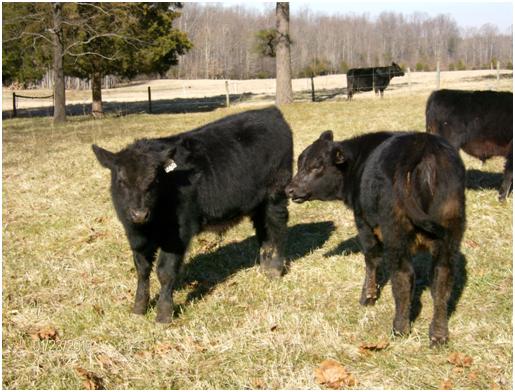
This lot was broadcast to Korean lespedeza and ryegrass and vetch on 2/27/10. The corner is currently divided into two lots but is estimated to offer 18 days of MIG grazing. Pictured are Ulysses and Ursula who are both already registered and the future of my herd. They are both sired by Diamond D Sure Enough 6D.
This lot is projected to offer 18 days of MIG grazing.

Warm Season Grasses


Tate’s Tips
A Series of Reflections on growing grass for forage

Issue 6.

Warm Season Grasses

The first few paragraphs should look familiar to those who have followed the series as they are directly from the last article, but a good review.

There are many classifications of plants.

There are annual plants and these are plants that usually grow for a single season or a single crop. Annuals include tomatoes, potatoes and, in fact, most vegetables; corn, wheat, beans and most other commodity crops and forages such as Oats, millet, Crimson clover, sudex, sudan grasses and turnips, canola and other brassicas.

There are a few biannual plants which have a two year life cycle. The most notable of these from a production standpoint would be red clover, a very useful legume. Another would be Canada thistle, a weed.

Then there are longer lived plants which are known as perennials. Their lifespan is determined to a large degree by the growing conditions and management they are exposed to. These would include many of the common pasture and hay grasses such as Orchardgrass, Fescue, Bluegrass, Timothy, Switchgrass, Indiangrass, Bluestem, Bermudagrass, Crabgrass and legumes such as White Clover, Ladino clover and several other clovers, Alflafa, Birdsfoot trefoil and lespedeza.

Some plants like ryegrass have cultivars that are annual and others that are perennial. Crabgrass can come back from the roots but it sets so many seed so quickly, that once you have a good stand it will stay with you for a long time.

Of the plants named above, many were warm season plants and some were cool season plants.

Corn is the ultimate warm season plant. When it is so hot and sticky that you are uncomfortable; corn, given adequate moisture, grows so fast that the growth is almost visible. In the late spring you can measure a day’s corn growth. However any frost will damage corn terribly as it does not tolerate cold weather.

Okay….now we will start fresh.

This year (2010) has made me look like a genius to those who have read the previous articles. Sadly it is just the accumulated wisdom of a lot of bad luck over a lot of years. It is late August 2010 as I address keyboard now.

Everything bad in weather has been dealt to us in spades this year. We had record snow fall in the winter and the wettest winter on record. When spring finally came and it stopped raining, forage producers went to the hayfields this spring, where they found thin stands and reduced yields. We can only surmise that many of the grasses drowned out in the winter and wet spring. Not all farms saw significant decline but many did.

The spring started off like gangbusters otherwise. At first we had what appeared to be the most uniform and potentially best corn crop that I have ever seen in this area. Everywhere I looked corn was beautiful and growing like gangbusters. It was uniform because the wet ground had kept everyone from planting until the ground dried out enough to get equipment on it.

It was beautiful and just about to tassel when the weather changed. Late May it got HOT and it Got DRY. One thing about corn is that it needs moisture when it is in the reproductive stage commonly referred to as tasseling. Corn can stand hot weather but it has to have water. 105 degree days took water away from the soil as if it were being drained. This is the exact opposite of what was needed.

I have been around here a lot of years and I do not recall a year where the corn had no ears. That was the case in a lot of fields this year. Some of the guys say 1977 was as bad. I was in Ohio digging out of snow that year.

When there is not enough water for corn to make ears……..and the weather is hot…..then cool season grasses are in trouble.

Grass weakened by the wet weather and then mown or grazed and then baked for weeks on end…..will mostly be reseeded or overseeded this fall. (We have two no till drills that we rent out for reseeding use.)

The bright spot in many places has been the warm season grasses. At my place, bermudagrass, or common wiregrass, has saved my butt this year. That and the fact that I have been doing Management Intensive grazing has kept me grazing all summer while all around me have been feeding from the short hay supplies harvested in the spring.

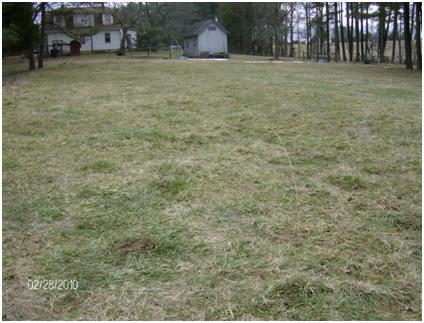
The photo below was taken of a daily grazing strip which had just been grazed. The date on the photo is 5/15/2010. The clumps are remnants of cool season grasses and the finer stuff is bermudagrass that was just emerging and spreading to fill in the voids. At that time I was worried about it but now am thankful it did.

The bermudagrass is the only thing I had to regrow after first grazing up until two weeks ago when we finally got a shower or two of rain. My cows and horses have been living on bermudagrass and the occasional sprig of crabgrass since mid early June.

Retired NRCS agronomist Glenn Johnson told me many times that he thought that Eastern Virginia forage producers were missing the boat by not using more Bermuda and crab grasses and overseeding them in the fall with rye and ryegrass. I have perennial ryegrass on my shopping list for this week. Because I know that when frost hits the Bermuda I am out of grass.

Warm season grasses will not stockpile like fescue. Well you can grow a pile of it and leave it out there but when it is frosted it goes dormant and loses feed value rapidly.

The nature of warm season grasses is they are only of value when it is warm. Even warm season grasses need moisture though.  the value of warm season grasses is that they grow at a prodigious rate makeing lots of forage in a short time.

I got a phone call from an old friend and a former boss, ( I feel proud of myself to count a former boss as an old friend) who had planted some Teff grass this year and he was bragging on it and sent me some photos. He was waiting for it to quit raining so that he could mow it again.

This photo was taken in southwestern Hanover county in August 2010. The teff was seeded I think he said in June. He has planted some for grazing as well and says Hereford cows love it and it holds up fairly well if given some rest.

Looks like a good leafy forage that he says makes excellent hay of good nutritional quality

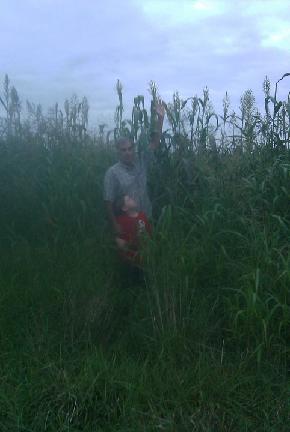
My son is farm manager on a good sized farm in Goochland and he addressed the hay shortage by planting two warm season annuals…..brown top millet and sudex. He has baled a section of the millet and got 83 round bales but I do not know the acerage. He is mowing the sudex pictured below today and says it is now ten or twelve feet tall and he is expecting 400 round bales. This is too tall to be optimum but the rain of the last two weeks, and they have had substantial rain over there, has prevented harvest. Even over mature hay is “Better than snowballs” as old Tom Goins used to say to me many years ago.

These are but some examples of warm season grasses and the benefits thereof.

Warm season grasses are grasses that oddly enough grow in warm season of the year. Most do not even begin to be productive until it is nearly hot. They are not drought proof and need water to survive and thrive. They will survive generally with less water than cool season grasses require.

Warm season grasses can be annual or perennial.

Annuals include millets, sorghums, sudexes, sudan grasses, forage peas Johnson grass and some newer stuff like Teff grass.

Perrenials include bermudagrass, crabgrass, switchgrass, bluestem, indiangrass, buffalo grass and others.

Bermuda and Crab are lower growing and both are actually not native to our area. But they are easily grown and have a natural place in forage rotations. Many of our cool season pastures actually have a significant amount of Bermuda and crab in them but they are not noticed as the livestock like them very well. Crabgrass is very palatable to most livestock. Dr. Teutsch is doing significant research on these alternative feeds at the Southern Piedmont Agricultural Research Center.

Further south Bermudagrass is big business. Most varieties are hybrid and are planted by sprigging vegetative cuttings. There is not much sprigging equipment to be found in Va. In the last few years a few seeded varieties of improved Bermudagrass have been developed and are commercially available. There are now improved crab grass seeds available as well. Dr. Teutsch has indicated that some of the local common Bermudas are doing very well in his research.

The others grasses above are termed native grasses and there is a long list of them. They make good forage, require low inputs, are adapted to our area and provide tremendous wildlife benefits, but they cannot stand close or continuous grazing and are more difficult to establish. They are more suited to mechanical forage harvesting, but as large bunch grasses they require a different management than our cool season hay mindset. These forages are also seeing increased used as biomass fuels. Those growers are teaching traditional producers how to manage these ‘new ‘old crops.

Monocultures are not nature’s way. Forage species diversity is good and should be encouraged. As people we have aesthetic landscapes in our minds eye as goals but those goals are difficult and expensive because you have to defeat Mother Nature to get there.

Some of the best graziers in our country value their pastures by the number and diversity of species of grasses that exist in the pasture.

Our new “traditional” “production driven” agriculture has given us the technology to strive toward the desired monocultures. I am not sure we know the true cost.

The older I get the more I see that it is a lot easier to work in concert with mother nature than it is to battle her. I try to approach all things with a mind toward moderation. I strive not to be an extremist in any direction, although some would paint me as the poster child of some extremes. I am currently trying to reduce inputs and increase management and observation. It costs me very little to observe nature at work.

My observation today, is that warm season forages have a place in our systems. We need to embrace them and determine how we can best utilize them in a balanced forage production scheme.

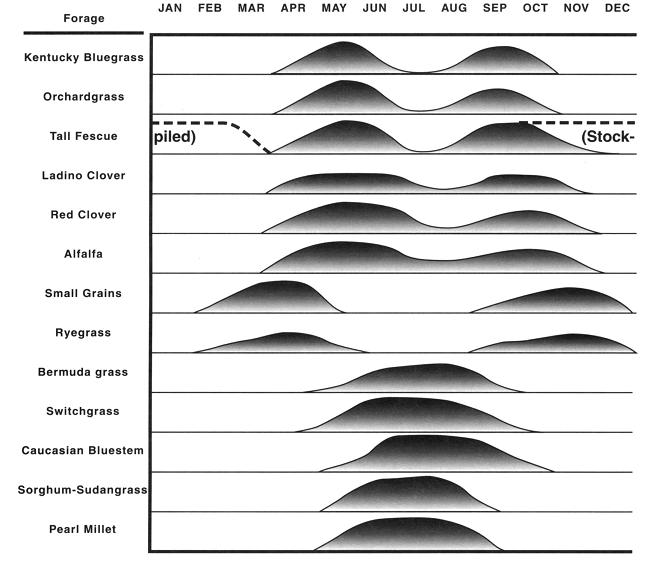
Some excellent reference reading links are below for those who want to learn at a more in depth level as well as the forage seasonality chart. (EVERY Forage grower should know this chart by heart).

The first two are basically the same. One is a web page and the other is a PDF file. I find the PDF file to be more useful.

The third link is to a list of publications by Dr. Chris Teutsch who is Virginia’s current leading authority on forages.

Click to access 418-012.pdf

http://www.pubs.ext.vt.edu/418/418-012/418-012.html

http://www.arec.vaes.vt.edu/southern-piedmont/people/teutsch/index.html

http://pubs.ext.vt.edu/418/418-105/418-105.html

Chart taken from controlled Grazing of Virginia’s pastures

Cool Season Grasses


Tate’s Tips

A Series of Reflections on growing grass for forage


Issue 5.


Cool Season Grasses

 There are many classifications of plants.

 There are annual plants and these are plants that usually grow for a single season or a single crop.  Annuals include tomatoes, potatoes and, in fact, most vegetables;  corn, wheat, beans and most other commodity crops and forages such as Oats, millet, Crimson clover, sudex, sudan grasses and turnips, canola  and other brassicas.

 There are a few biannual plants which have a two year life cycle.  The most notable of these from a production standpoint would be red clover, a very useful legume.   Another would be Canada thistle, a weed.

 Then there are longer lived plants which are known as perennials.  Their lifespan is determined to a large degree by the growing conditions and management they are exposed to.  These would include many of the common pasture and hay grasses such as Orchardgrass, Fescue, Bluegrass, Timothy, Switchgrass, Indiangrass, Bluestem,  Bermudagrass, Crabgrass and legumes such as White Clover, Ladino clover and several other clovers, Alflafa, Birdsfoot trefoil and lespedeza.

 Some plants like ryegrass have cultivars that are annual and others that are perennial.  Crabgrass can come back from the roots but it sets so many seed so quickly, that once you have a good stand it will stay with you for a long time.

 Of the plants named above, many were warm season plants and some were cool season plants.

 Corn is the ultimate warm season plant.  When it is so hot and sticky that you are uncomfortable; corn, given adequate moisture, grows so fast that the growth is almost visible.  In the late spring you can measure a day’s corn growth.  However any frost will damage corn terribly as it does not tolerate cold weather.

 On the other hand small grains like wheat and barley and rye and canola are cool season annuals that in our state are planted in the fall and they overwinter to flower and fruit in the spring.  They tolerate cool weather better than corn and in fact do not perform as well in summer heat.  There are western varieties that are grown in the northwest United States that are summer varieties.  Plants are amazing at their ability to adapt and perform in so many different environments.

 The focus of this article is intended to be on cool season perennial forages that are common to Virginia.  Within this category, what is common in the eastern coastal plain and what is common in the mountain west and southwest parts of the state may be very different.

 Let’s start simple.  Cool season grasses prefer the cool seasons of spring and fall.  Freezing weather will cause them to go dormant, but they overwinter well.  Hot dry weather will cause dormancy too and extreme heat and dry can be fatal to some cool season grasses.  Generally cool season grasses and mixtures should be planted in the early fall.  They can be planted in the spring but weed pressures and environmental factors are more inhibiting to a successful establishment.  Summer and winter plantings need extreme luck and management to survive.

 Oats is a cool season plant that has varieties that can be planted in the fall called winter oats, and also there are spring planted varieties called spring oats.  Spring Oats are not cold tolerant and will winter kill.  Both are annuals and both can be used as forage as silage or hay or harvested at maturity for grain and straw.  The spring oats would mature at a later date.  Once harvested they are essentially done.  Oats are sometimes used as a nurse cover crop for new seedings of perennial forages.  Now wasn’t that easy.

 Timothy  is a cool season perennial except in the eastern half of Virginia.  While it is excellent forage and makes good grazing or hay, it is not hardy enough to persist in the hot and dry part of the commonwealth.  The hay producers in eastern Virginia interseed timothy annually in their hay fields to provide it to the customers who prefer it.  A spring cutting can be made and then the timothy perishes due to heat and dry conditions.  Basically one could say it is the coolest of the cool season grasses with no tolerance for hot dry conditions.  It can be a perennial in the high mountains and in southwest Virginia.  See still easy.

 Bluegrass  is a cool season perennial that will persist under hay making conditions and will survive the stress of hot and dry.  It will not be productive during that time but it will survive.  It is a smaller finer forage that makes excellent forage but lesser tonnage than some other grasses.  Does not handle stress and close grazing so it does not survive well in continuous grazed pastures.

 Orchardgrass is a cool season perennial that is close to blue grass in hardiness.  It is a larger and more productive plant and has a deeper root base than bluegrass.  Recall that the more plant we have above ground the more root mass we have underground.  It produces excellent quality forage and under well managed hay programs I have observed stands of Alfalfa and Orchardgrass that were 18 years old.  It will persist in summer with moisture.  If temperatures are moderate and moisture is adequate it will produce multiple hay cuttings.  If these conditions are not met it will simply go dormant until favorable conditions return.  It also is excellent pasture forage but it must have rest.  Continuous grazing will kill Orchardgrass.  Extreme drought will also kill Orchardgrass but it will survive a typical Virginia summer.

(Please refer back to Issue 2, How does your Plant Grow? For a refresher on this concept.)

 Now having read the refresher and eaten a few cookies, this too is simple, Right ??

I should not reveal all this as we make good money for our scholarship fund renting no till drills to folks who plant Orchardgrass every year.

 Ryegrass is both an annual and a perennial depending upon the variety.  It is a vigorous and copious seed producer and if allowed to set seed will be a recurring annual.  Rye grass is an easy starter and a vigorous grower and produces high quality palatable forage suitable for pasture and for hay or silage.  It is useful for getting fast establishment on bare areas and is tolerant of a wide variety of growing conditions.  It also is not a heat tolerant plant in either annual or perennial variety.  It is the first grass to green up in the spring and the last to quit growing in the fall and I include it in my recommended mixes as it has the greatest chance at establishment.  As a cool season grass it is virtually dormant in most summers but will reemerge with cooler weather and rain. 

 Use ryegrass with caution if you adjoin a small grain production field.  Ryegrass is a serious weed in small grains and is invasive and difficult for grain producers to control.  I have no desire to be implicated in causes of gunplay between neighbors.

 Have you noticed a trend yet?

All of these grasses in most Virginia summers experience what is called summer slump.  The heat and dry conditions are just too much for them and they shut down until conditions improve.  Some more than others.   Everything is still simple so far except that we don’t have any summer grass yet.  We will get there later.  Refer to the chart below taken from Controlled Grazing of Virginia’s Pastures for a graphic representation of what we have discussed so far.

 Fescue is the most common and most abundant and hardiest and most productive of the cool season grasses.  Fescue stands up to hard grazing better than any of the other cool season grasses.   It will still have a summer slump because it is still a cool season grass.  But it will survive.  Fescue is a bit less palatable than some of the other grasses.  It still makes good forage and grazing but given a buffet of ice cream, pizza, hamburgers, and brussle sprouts, the brussle sprouts don’t have to worry about me bothering em.  Fescue is the forage equivalent of brussle sprouts.  Eat em cause they are good for you.  Yeah Mom, soon as I polish off this pizza.

 Animals select the most palatable plants first and go back for regrowth as soon as it appears.  They will graze around the tougher fescue until the ice cream is gone and then they will eat the brussle sprouts (fescue).  This natural animal tendency puts negative pressure on the Orchardgrass and positive selection pressure on the fescue.

 Fescue is a complicated grass as well.  It gets a good part of it’s hardiness from an organism called an endophyte.   The endophyte is a microscopic organism that lives in fescue and concentrates in the seed heads.  Rather than pay rent the endophyte benefits the fescue plant contributing to the plants hardiness. 

 The endophyte also has the side effect of some toxicity to animals.  In cattle it increases summer slump by restricting blood flow in the animal and creating over heating problems and thereby suppresses animal production and performance.  It can have reproductive repercussions as well in cattle.

 In horses the problem is in pregnant mares.  Pregnant mares exposed to the toxic endophyte with have a high percentage of foaling problems.  I will leave it to discuss with your equine practitioner for specifics. 

 Once the troublesome endophyte was discovered quite a few years ago, enterprising plant pathologists were successful in removing the endophyte and created;

  Endophyte Free Fescue  Seed is available for endophyte free fescue today and it eliminates the toxicity problems of fescue.  In fact it made fescue a more palatable plant and made it more like Orchardgrass.  The problem is that the endophyted free fescue is now no hardier than Orchardgrass.  For the good forage manager this is not too much of a problem as the fescue can be managed right along with the Orchardgrass.  For those who overgraze…..you just ran out of grass again.

 The newest option is a fescue which has been developed with a novel endophyte that gives the fescue its hardiness back and yet eliminates the toxicity of old Kentucky 31.  Only one seed company has this product and the seed is a bit expensive but it is a good product that works.  Over time native Kentucky 31 can infiltrate a stand of Endophyte friendly fescue and it is not discernibly different.

 My advice for mare owners is to keep pregnant mares off of fescue and cattle can be selected for fescue adaptability as some cattle are much more tolerant of it than others.  Interseeding of fescues with other grass and particularly legumes is of great benefit.  Pasture management is an integral part of managing the toxicity problems.  Clipping of seed heads reduces problems greatly as well.

 Matua  is a new variety of brome grass that seems to be relatively well adapted to Virginia.  It is a good and vigorous producer but needs management similar to Orchardgrass to maintain a good stand.

 We have yet to cover warm season grasses or legumes.  We will hit those in the next two topics.

 Some excellent reference reading links are below for those who want to learn at a more in depth level as well as the forage seasonality chart.

 The first two are basically the same.  One is a web page and the other is a PDF file.  I find the PDF file to be more useful. 

 The third link is to a list of publications by Dr. Chris Teutsch who is  Virginia’s current leading authority on forages.

 http://www.pubs.ext.vt.edu/418/418-012/418-012.pdf

 http://www.pubs.ext.vt.edu/418/418-012/418-012.html

http://www.arec.vaes.vt.edu/southern-iedmont/people/teutsch/index.html

 http://pubs.ext.vt.edu/418/418-105/418-105.html


 Chart taken from controlled Grazing of Virginia’s pastures